
Learn / DaVinci Resolveupdated for DaVinci Resolve 21.0.2 and Canva Video (July 2026)
DaVinci Resolve vs Canva Video Editor for Beginners
Quick answer
Canva edits faster for short, templated social clips but can't grade color, mix multi-track audio, or handle growing projects. DaVinci Resolve's free edition does all three with no watermark, at the cost of a steeper first session. Pick Canva only for a single quick clip you'll never revisit.
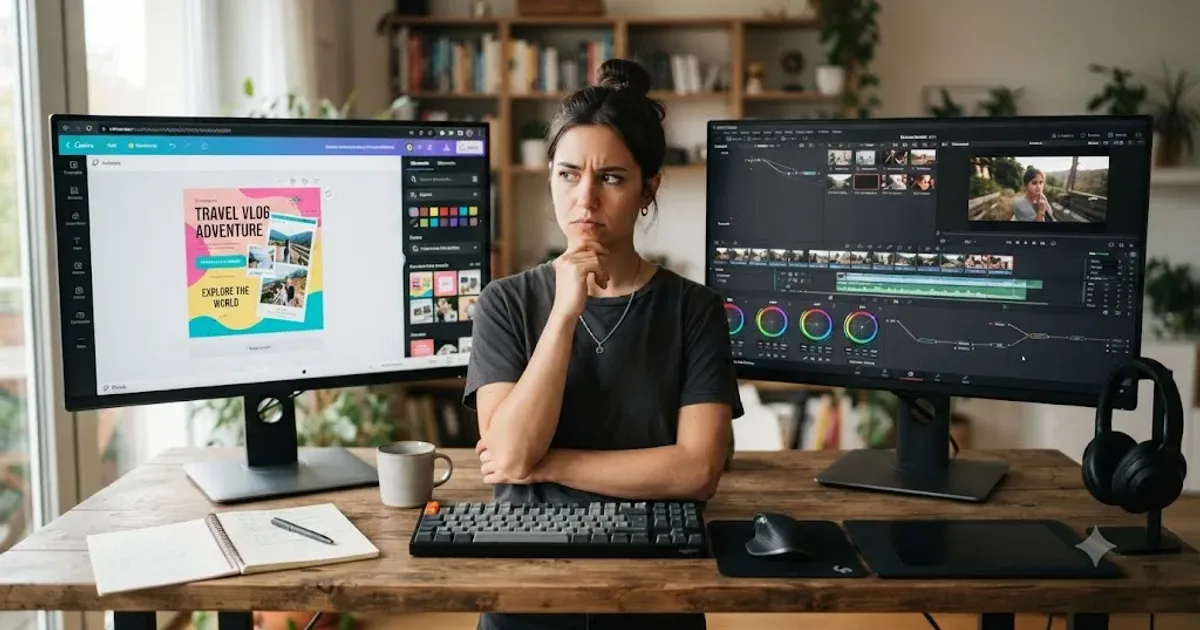
You've used Canva for a thumbnail or two, maybe a carousel post, and now someone's asking for an actual video. Canva has a video editor now, so why not just use that? Or is DaVinci Resolve, the free-but-intimidating tool everyone keeps recommending, actually worth the extra setup for a first project?
That's a fair question, and it deserves real numbers instead of a vague "it depends." Here's the honest version: what each tool is actually built for, what Canva's video editor can and can't do in 2026, what DaVinci Resolve's free edition gives you that costs nothing, and which one to open first depending on what you're actually trying to make.
DaVinci Resolve vs Canva for beginners: the quick verdict
Before the details, here's the shape of the whole comparison in one table. Every row gets its own section further down, with sources.
| Category | Winner | Why |
|---|---|---|
| Speed for a single quick clip | Canva | Drag-and-drop templates, no import step, no timeline to learn from scratch |
| Cost | DaVinci Resolve | Free edition costs nothing and has no watermark; Canva's free plan caps export quality and gates features behind Pro |
| Color grading | DaVinci Resolve | Node-based color page with wheels, curves, and scopes; Canva has no professional color tools at all |
| Audio editing | DaVinci Resolve | Fairlight is a full multi-track mixer; Canva has no multi-track audio editing |
| Learning curve, first hour | Canva | Fewer concepts, more guided defaults, closer to graphic design than editing |
| Learning curve, first month | DaVinci Resolve | Skills transfer to real production work; Canva's ceiling is templates and stock assets |
| Templates and stock library | Canva | 610,000+ premium templates and 100M+ stock assets on Pro |
| Growing past a single clip | DaVinci Resolve | Handles multi-track projects, longer footage, and repurposing without hitting a wall |
Neither tool wins every row, and the honest answer is that most beginners eventually need both, just for different jobs. What follows is why each row shakes out this way, so you can weigh the ones that actually matter for what you're making.
What are Canva and DaVinci Resolve actually built to do?
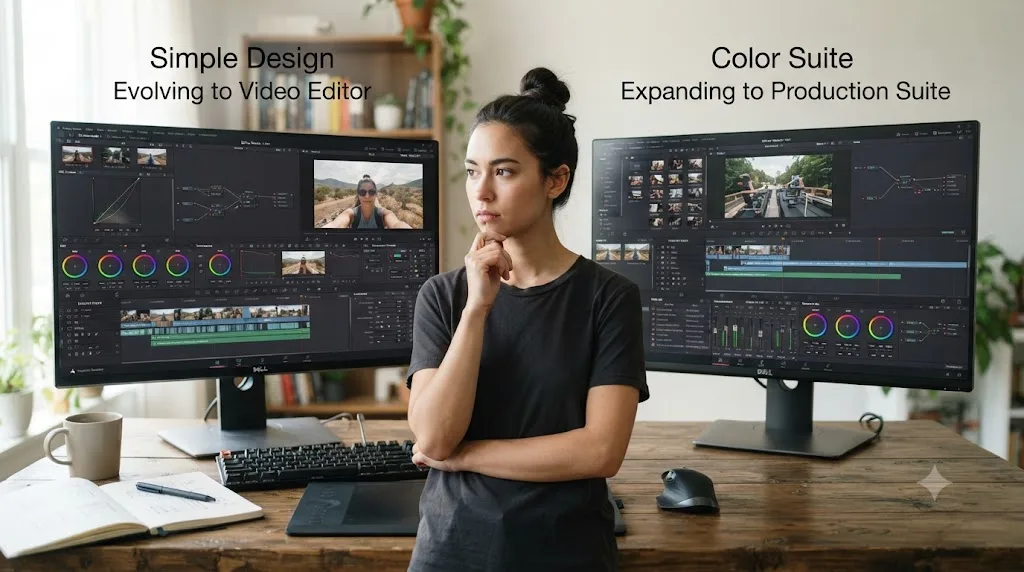
This is the question that settles most of the confusion, because Canva and DaVinci Resolve aren't really competing products. They're built around different jobs that happen to overlap on one task: putting a video together.
Canva started as a graphic design tool, and its video editor grew out of that foundation rather than being built from scratch as an editor. As of the June 2026 update, Canva Video has a functional timeline with trim-and-split tools, animated transitions, AI Highlights, and Enhance Voice for background noise removal, according to a detailed 2026 review of Canva's video editor. That's real progress from the "photo slideshow with music" version of Canva video a few years back. But the design-first DNA still shows: Canva's whole interface is organized around templates, brand kits, and a library of premium elements, not around frame-accurate editing.
DaVinci Resolve was built the opposite way. Blackmagic Design's own product page describes it as software that "combines editing, color correction, visual effects, motion graphics and audio post production all in one software tool" for "feature films, commercials, television shows and social media content" per Blackmagic's product page. It splits into seven pages, Media, Cut, Edit, Fusion, Color, Fairlight, and Deliver, each one deep enough to be its own dedicated application in a different editor's world. A beginner touches maybe two or three of those pages for a first project. The rest sit there, unused but not in the way, waiting for the day you need them.
A design tool with a timeline bolted on is not the same thing as a video editor with a design tool bolted on. That's the whole distinction, and it explains almost everything else in this comparison. Canva got good at video by extending what it already did well. DaVinci Resolve got good at design-adjacent tasks (titles, graphics, templates) as a side effect of already being a full production tool. Neither approach is wrong. They just answer different questions about what you're actually trying to build.
| Canva | DaVinci Resolve | |
|---|---|---|
| Started as | Graphic design tool | Color grading software (acquired and expanded into a full NLE) |
| Core strength | Templates, brand assets, stock library | Editing, color, audio, and VFX in one app |
| Video editor added | Layered onto an existing design platform | Built as one of the app's core pages from the start |
| Best at | Fast, templated, branded short content | Anything from a quick cut to a full production pipeline |
How much do Canva and DaVinci Resolve cost?
This is usually the first question a beginner actually asks, and it's also the row with the most misleading assumptions baked in.
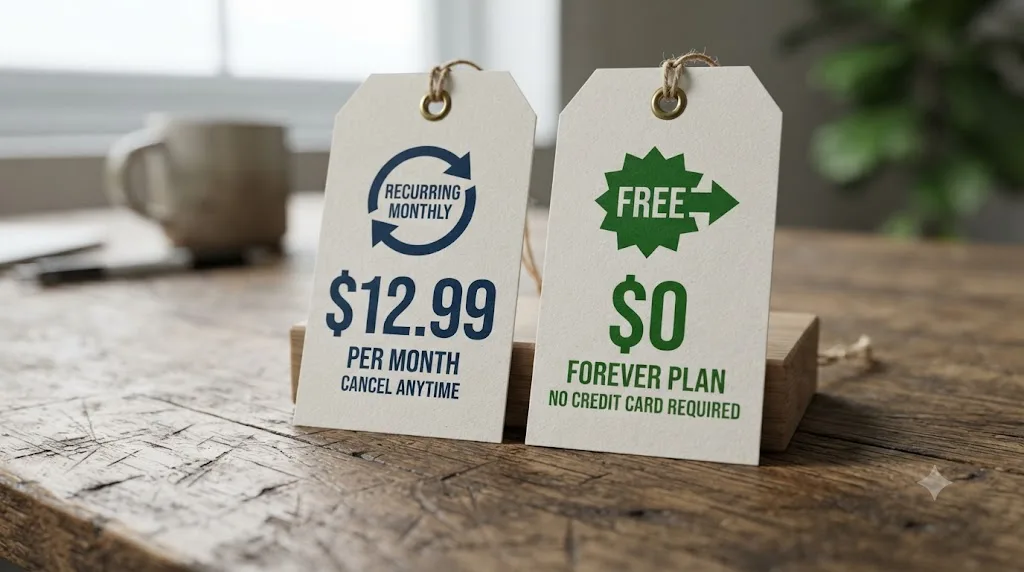
Canva's free plan includes core video editing at 720p export quality, with a watermark on some premium features and limited AI credits, per the same 2026 Canva video editor review. Canva Pro costs $14.99 a month billed monthly, or roughly $6.50 a month if you commit to annual billing, and it unlocks 1080p exports, Brand Kit support, 1TB of storage, background removal, and access to Canva's full library of premium templates and stock assets. Check Canva's own pricing page for your region's current rate, since Canva's plans and included storage have shifted more than once.
DaVinci Resolve ships in two editions, and the free one is genuinely free, not a trial. Per Blackmagic Design's own Studio product page and a detailed breakdown from Toolfarm of what's actually missing from the free edition, the free edition has no watermark, no time limit, and exports up to Ultra HD resolution (3840x2160) at up to 60fps. DaVinci Resolve Studio removes that resolution cap and adds the Neural Engine's AI tools for a single $295 payment, with no subscription and no recurring fee ever.
DaVinci Resolve's free edition costs nothing and outclasses every video feature Canva Pro charges for. That's not a marketing line, it's what the feature lists actually say when you put them side by side. Canva Pro's $14.99 a month buys you a bigger design library and higher export resolution. It doesn't buy you color grading, multi-track audio, or chroma key, because Canva doesn't have those features at any price tier.
| Product | Price | What it unlocks |
|---|---|---|
| Canva (free) | $0 | 720p export, watermark on some features, limited AI credits |
| Canva Pro | $14.99/mo, ~$6.50/mo annual | 1080p export, Brand Kit, 1TB storage, background removal, premium templates and stock |
| DaVinci Resolve (free) | $0 | No watermark, no time limit, Ultra HD export, full color/audio/VFX pages |
| DaVinci Resolve Studio | $295 one-time | Everything in free, plus Neural Engine AI tools, higher-than-4K export, collaboration mode |
Here's the practical math that matters for a beginner specifically. If you're editing occasionally and mostly need templates and stock footage, Canva Pro's monthly fee buys real value you'd otherwise have to source yourself. If you're editing regularly and want the actual craft of editing (real color, real audio, real trims), DaVinci Resolve's free edition gives you a professional toolset at a price that beats every tier Canva offers, including the free one, since Canva's free plan still caps you at 720p and watermarks some features.
Which one is easier to learn on day one?
Canva, without much argument, for the first session specifically.
Canva's video editor inherits the same drag-and-drop logic as its design tools. You pick a template or start blank, drop in clips and text, and the interface guesses at reasonable defaults for timing and transitions. There's no Media Pool to understand, no Project Settings to configure before you start, and no separate pages to get lost between. If you've ever built a slide deck or a social graphic in Canva before, the video editor feels like an extension of something you already know, not a new tool.
DaVinci Resolve's learning curve is steeper for one specific, structural reason: it's actually five distinct applications (Edit, Color, Fairlight, Fusion, and the simplified Cut page) wearing one interface. A total beginner who opens Resolve for the first time and lands on the Color page's node graph, or worse, the Fusion compositing canvas, can walk away convinced the whole application is too much for them. Jourdan Aldredge, writing for No Film School about Blackmagic's own beginner's guide, doesn't sugarcoat that first impression: getting started with DaVinci Resolve can feel intimidating, whether you're new to editing entirely or switching over from another app.
That first impression is real and worth taking seriously rather than waving away. It's also not the whole story. DaVinci Resolve is overwhelming from the Color page and approachable from the Cut page, and which one you land on first decides your entire first impression of the software. The Cut page strips away almost everything a beginner doesn't need yet: a source tape view, a single-track-first layout, and big, obvious trim tools that behave a lot like what you'd expect from a simpler app. Starting there instead of the full Edit page is the single biggest decision a Canva-to-Resolve beginner can make.
| First-session task | Canva | DaVinci Resolve (Cut page) | DaVinci Resolve (Edit page) |
|---|---|---|---|
| Import footage | Drag and drop, instant | A minute or two to find the Media Pool | Same as Cut page |
| Trim a clip | Drag the clip edge | Blade tool or a keyboard shortcut, quick once learned | Same tools, more surrounding panels to ignore |
| Add text | Click a text template | Text+ titles, more setup the first time | Same |
| Add a transition | Drag one onto the cut point | Built in, fewer preset options than Canva | Same |
| Export | One button, platform presets | Deliver page, or Quick Export with named presets | Same, more manual options visible |
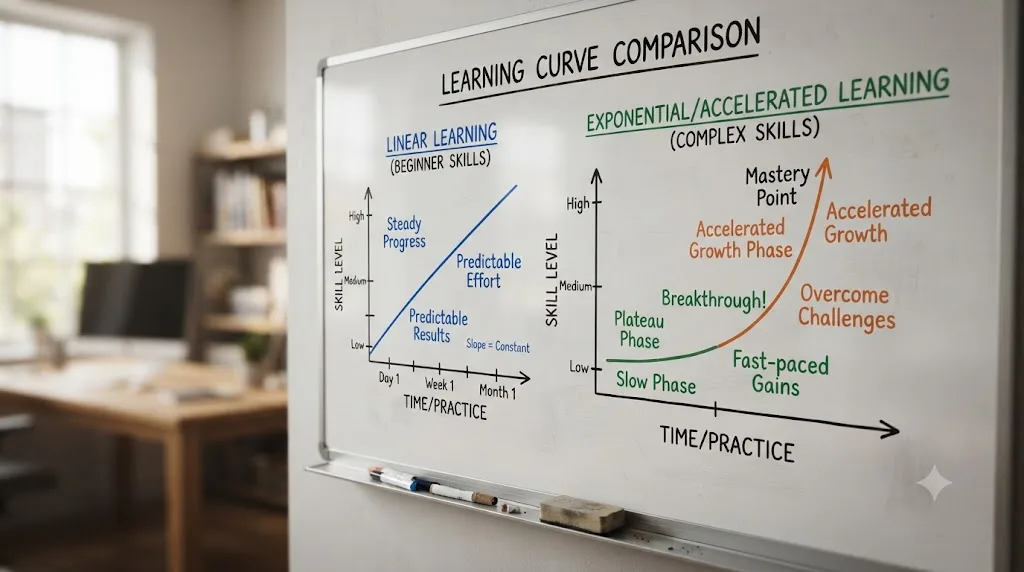
Neither learning curve is permanent. Canva's stays flat forever, since there's no deeper mode to grow into. DaVinci Resolve's drops fast after the first project, once Project Settings, the Blade tool, and the Cut page's layout stop requiring conscious thought.
What can Canva's video editor actually do, and where does it stop?
Naming this plainly is the honest way to judge whether Canva is enough for your project, rather than assuming either way.
Canva Video genuinely handles the basics of assembly: timeline-based editing with clip trimming, splitting, and reordering across multiple video tracks, animated transitions like fade, slide, and dissolve, text overlays with built-in animation styles, audio import with basic volume control, and watermark-free export at 1080p on Pro, per the fluxnote review of Canva's video editor. The June 2026 update added frame-level scrubbing and caption controls on top of that. For a branded social clip built from a template, that's a genuinely complete toolset.
Where it stops is just as concrete. Canva has no chroma key or green screen compositing, no control over codec, bitrate, or container format on export, no professional color grading tools (no curves, no color wheels, no scopes), and no keyframe animation for building custom motion graphics, according to the same review. Canva's AI-generated video clips are capped at 8 seconds per generated clip as of the June 2026 update, which matters if you were hoping to lean on AI generation for anything longer than a quick insert shot. A separate 2026 review from bityclips puts a number on where the format genuinely works: videos up to about three minutes handle well in Canva's editor, and the timeline becomes "unwieldy" past that, with the same review explicitly recommending a move to Premiere Pro, DaVinci Resolve, or CapCut Desktop for longer projects.
Audio is the gap that surprises the most people coming from a design background, since it doesn't show up until you actually need it. Canva has no multi-track audio editing. You get a volume slider and Enhance Voice's automated noise reduction, not a channel-strip mixer, not independent EQ per track, not the ability to duck a music bed under a voice track with any real precision. Erik Bassett, reviewing the editor directly on Medium, put the audio limitation about as plainly as it gets:
"It's easy to set the playhead, right-click on it, and split a video clip. But splitting audio? Forget about it."
Bassett's broader verdict on the tool is worth reading in full rather than cherry-picked, because it's fair to Canva as much as it's honest about the ceiling: "It's obviously a non-start for heavy-duty video editing or for any animation" (source: Erik Bassett's Canva video editor review, Medium). That's not a hit piece. It's someone who used the tool describing exactly where its floor and ceiling sit.
| Canva capability | What it covers | What it doesn't |
|---|---|---|
| Timeline editing | Trim, split, reorder, multiple video tracks | Frame-accurate multi-track sequencing across dozens of clips |
| Transitions | Fade, slide, dissolve presets | Custom, keyframed, or hand-built transitions |
| Color | Basic filters and presets | Curves, wheels, scopes, node-based grading |
| Audio | Volume slider, Enhance Voice noise removal | Multi-track mixing, EQ, ducking, independent processing |
| Compositing | None | Chroma key, green screen, layered masking |
| Export control | Resolution only (720p free, 1080p Pro) | Codec, bitrate, or container format choice |
There's also a hard technical ceiling worth knowing before you build a project around it: any single video file imported into Canva caps at 1GB, a single design can hold up to 350 total videos including stock footage, and free accounts get a 5GB storage limit before uploads get blocked, according to a 2026 breakdown of Canva's video limits. For a single social clip, none of that matters. For a longer project built from many high-resolution source files, it starts to.
What does DaVinci Resolve's free edition give you that Canva doesn't?
Everything the section above just said Canva was missing, at no cost, which is the part that tends to surprise beginners most.
DaVinci Resolve's Color page is a node-based system: discrete processing blocks you wire together in whatever order a shot needs, with a full scopes suite (waveform, vectorscope, histogram, parade) docked right next to the node graph. That's not a stretch feature bolted onto an editor. It's the reason DaVinci Resolve exists as a product in the first place; Blackmagic built Resolve as color grading software first, and the editing tools came later. Canva has nothing comparable at any price tier, since color grading was never part of what the product was built to do.
Fairlight, Resolve's audio page, is a real digital audio workstation living inside the same app as the picture editor, not a separate program you round-trip to. It supports a full channel-strip mixer, EQ and dynamics processing on every track by default, and dedicated tools for cleaning up dialogue, all included in the free edition. Where Canva gives you one volume slider and an automated noise-removal button, Fairlight gives you the actual mixing console a real audio pass needs.
Fusion, Resolve's compositing and motion graphics page, adds the keyframe animation and chroma key work Canva's reviews consistently flag as missing. Blackmagic describes Fusion as a 3D compositing workspace with more than 250 tools, covering vector paint, keying, rotoscoping, tracking, and particle systems, all inside the same project file as your edit and your grade.
Templates teach you to recognize someone else's timing, not to build your own. That line applies directly to the Canva-versus-Resolve gap on titles and motion graphics. Canva's text animations are presets: pick one, drop it on a clip, done. Resolve's Text+ and Fusion tools let you build a custom animation keyframe by keyframe, which takes longer the first time and produces something that's actually yours, not a variation of a template thousands of other creators are also using.
| Resolve page | What it adds over Canva | Included in the free edition? |
|---|---|---|
| Color | Node-based grading, curves, wheels, scopes | Yes |
| Fairlight | Full multi-track audio mixer, EQ, dynamics | Yes |
| Fusion | Keyframe animation, chroma key, 250+ compositing tools | Yes (Studio adds more Neural Engine extras) |
| Deliver | Codec, bitrate, and container control | Yes |
None of this means Canva is a worse product overall. It means Canva was never trying to be this product, and comparing its 1080p export toggle to Resolve's Deliver page is comparing two tools solving different problems. If your actual project needs any one of these four capabilities, Canva simply doesn't have a paid tier that adds it. Resolve has it built into the version that costs nothing.

Is DaVinci Resolve overkill if you only make short social clips?
This is the question that actually decides most beginners' choice, and it deserves a direct answer instead of a hedge.
Sometimes, yes. If you're editing exactly one video, ever, a single fifteen-second clip you'll never open the software again to touch, Canva's zero-setup speed wins outright. Opening a desktop app, importing footage into a Media Pool, and learning even the simplified Cut page all cost real minutes a browser-based drag-and-drop tool skips entirely.
But most people asking this question aren't editing exactly one video. Our full breakdown of whether DaVinci Resolve is overkill for simple social media edits walks through the exact threshold in more depth, and the short version applies directly here too: the learning cost is fixed and one-time, while the speed payoff compounds with every clip after the first. Canva's speed advantage doesn't compound the same way, since you're not building toward anything deeper each time you use it.
Where this comparison differs from a Canva-versus-CapCut question is templates. CapCut and Canva both specialize in fast, format-native social content, but Canva adds something CapCut doesn't: a full design ecosystem of brand kits, stock photography, and marketing templates that a video sits inside as one asset among many. If your actual job is "produce a branded social video that matches five other pieces of marketing collateral," Canva's design-first approach is a genuine structural advantage neither CapCut nor Resolve replicates. If your job is purely "cut this footage well," that advantage disappears and the comparison collapses back to editing depth, where Resolve wins clearly.
| Your situation | Overkill? | Better fit |
|---|---|---|
| One clip, ever, matching a Canva brand template | No, Canva's the right tool for this specific job | Canva |
| One clip, ever, from your own raw footage, no branding | Borderline; a phone editor may beat both | Canva or a phone-native app |
| Regular branded social posts, template-driven | Mostly Canva | Canva, unless color or audio needs grow |
| Regular posts from your own raw footage, any color work | No | DaVinci Resolve |
| Repurposing long-form video into multiple clips | No | DaVinci Resolve |
Which is better for repurposing long-form footage into multiple clips?
DaVinci Resolve, and this is one of the clearest wins in the whole comparison because it's the exact opposite of what Canva was designed around.
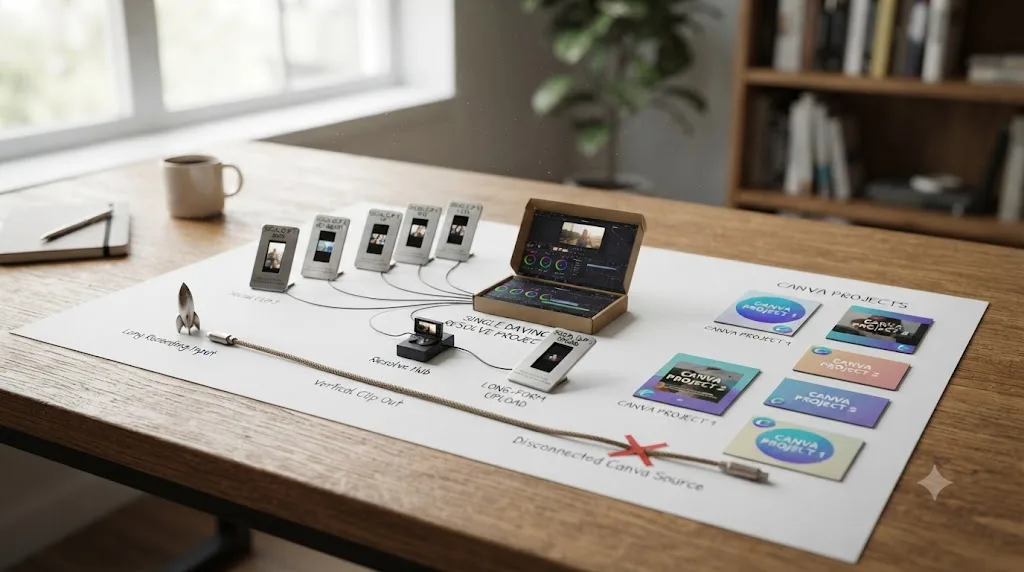
Say you record one 20-minute video, a tutorial, a podcast, a recap, and want to cut it into five short vertical posts for the week, plus keep the full-length version for YouTube. In Canva, that means importing the full recording, manually scrubbing through it to find five candidate moments (Canva has no marker-and-search system built for a long source), cutting each into its own separate project, and exporting five times with no shared organizational layer connecting them back to the original file. You'd also need a separate tool entirely to prepare the full-length horizontal version, since Canva's design center is short-form content, not long-form delivery.
In DaVinci Resolve, you import the recording once, mark candidate moments with typed keywords as you watch, search those markers through the Edit Index to shortlist the best five, duplicate the timeline once per clip, crop and caption each one, and export all five plus the original long-form cut from a single project and a single Media Pool. The organizational advantage isn't a nice-to-have here; it's the entire reason the workflow doesn't fall apart at scale. One import, one searchable marker system, and both outputs living in the same project beats five separate Canva projects with nothing connecting them.
A tool built for one output at a time falls behind fast the moment you need six outputs from one source. That's the practical, non-abstract version of "Canva doesn't scale past a single clip." It's not that Canva can't technically produce six videos. It's that producing them costs six times the manual effort with none of the shared context Resolve's project structure gives you for free.
Will either app actually run on your computer?
This matters more than most comparisons admit, because a tool that's technically capable but chokes on your specific hardware is functionally the wrong choice regardless of its feature list.
Canva is browser-based (with an optional desktop app), which means its hardware demands are mostly about your internet connection and browser performance, not raw CPU or GPU power. Almost any laptop from the last several years runs Canva's video editor without strain, since the heavy lifting happens on Canva's servers, not your machine.
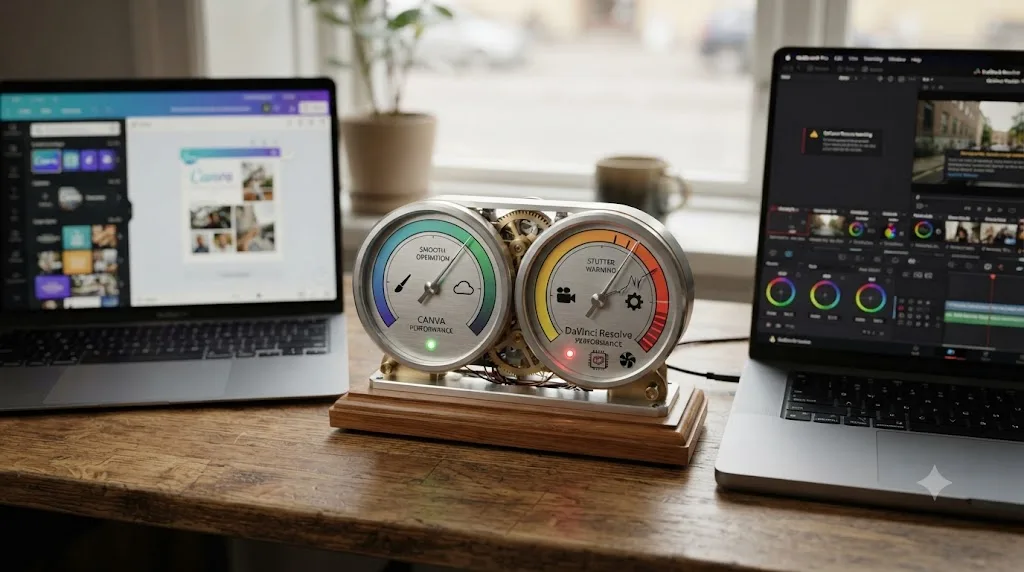
DaVinci Resolve is a full desktop application with real hardware requirements. Per a 2026 breakdown of Resolve's system requirements, the practical baseline is a quad-core processor (an Intel Core i5 6th-generation or an AMD Ryzen 5 equivalent), 8GB of system RAM, and a GPU with at least 2GB of VRAM supporting Metal, OpenCL, or CUDA depending on your platform. That's fine for a simple cut with light color and no Fusion work. Where beginners run into real trouble is 4K source footage on an 8GB machine with an older integrated GPU: playback stutters, exports crawl, and the experience feels like proof Resolve is too much, when the actual problem is a hardware mismatch.
| Your setup | Canva | DaVinci Resolve |
|---|---|---|
| Any laptop with a modern browser, decent wifi | Smooth, no meaningful lag | Depends on specs below |
| Apple Silicon Mac or recent Intel/AMD PC, 16GB+ RAM | Smooth | Smooth, no strain on a simple edit |
| Older machine, 8GB RAM, integrated graphics | Smooth (server-side rendering) | Workable for 1080p, may stutter on 4K or heavy color |
| No reliable internet connection | Doesn't work at all, Canva is cloud-based | Works fully offline once installed |
That last row cuts both ways and rarely gets mentioned. Canva needs a live internet connection to function at all, since your project lives on Canva's servers, not your device. DaVinci Resolve, once installed, edits and exports entirely offline. If you travel with spotty wifi, or your workspace has an unreliable connection, that's a real, practical reason to lean toward Resolve that has nothing to do with feature depth.
What if DaVinci Resolve feels too slow on your current computer?
This is the single most common reason a beginner abandons DaVinci Resolve mid-project, and most of the time it's fixable without buying new hardware.
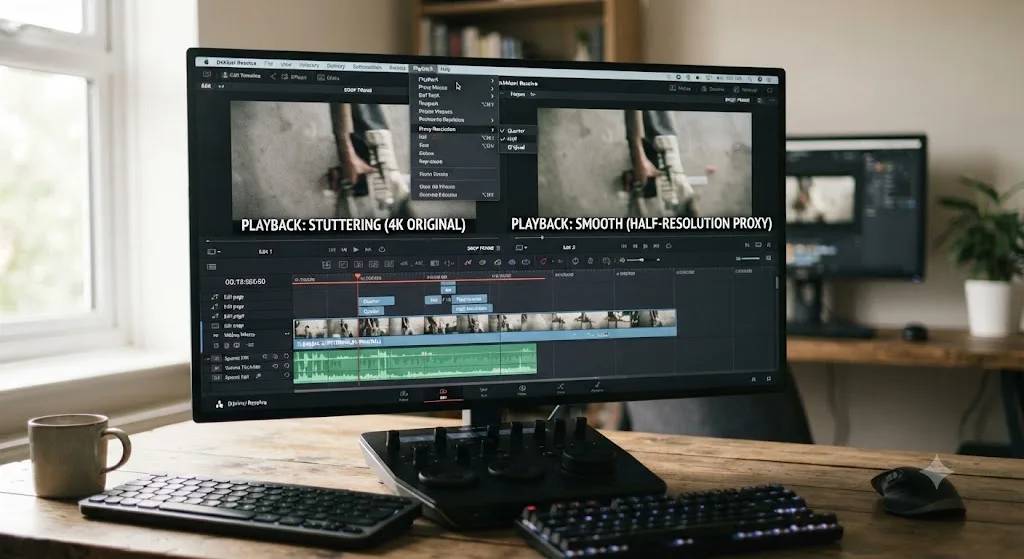
If you're on hardware near or below the baseline covered above, a quad-core CPU, 8GB of RAM, an older or integrated GPU, per CodeItBro's breakdown of Resolve's system requirements, and you're editing 4K footage, stuttery playback and slow scrubbing are expected, not a sign something's broken. Three things fix most of it before you touch a settings menu you don't recognize: drop your timeline proxy resolution (Playback menu, Proxy Resolution, set it to Half or Quarter) so Resolve decodes a smaller file while you edit and switches back to full resolution automatically on export; generate Optimized Media for your heaviest clips, which transcodes them into a format your GPU decodes faster; and turn off real-time effects preview on anything you're not actively adjusting, since a live Fusion composite or a heavy noise-reduction node redraws on every single frame whether you're looking at it or not.
If none of that gets you to smooth playback, the honest options narrow. Editing at 1080p instead of your source 4K, at least for the assembly pass, cuts the decode load roughly to a quarter. Beyond that, you're looking at either more RAM, a better GPU, or accepting that heavy color and Fusion work on this specific machine will always feel sluggish, in which case doing the rough cut in Resolve and reserving the actual grade for a session on stronger hardware is a reasonable compromise, not a reason to abandon the switch entirely.
A stuttering DaVinci Resolve timeline is almost always a proxy-resolution problem, not a verdict on whether your computer is good enough. Most beginners never touch the Proxy Resolution setting because nothing in the default interface points at it, and it's the single highest-value five-second fix on this entire page.
Does either tool work on a phone or tablet?
Yes, but the two apps take opposite approaches to what "mobile" means, and that split matters if most of your editing time happens away from a desk.
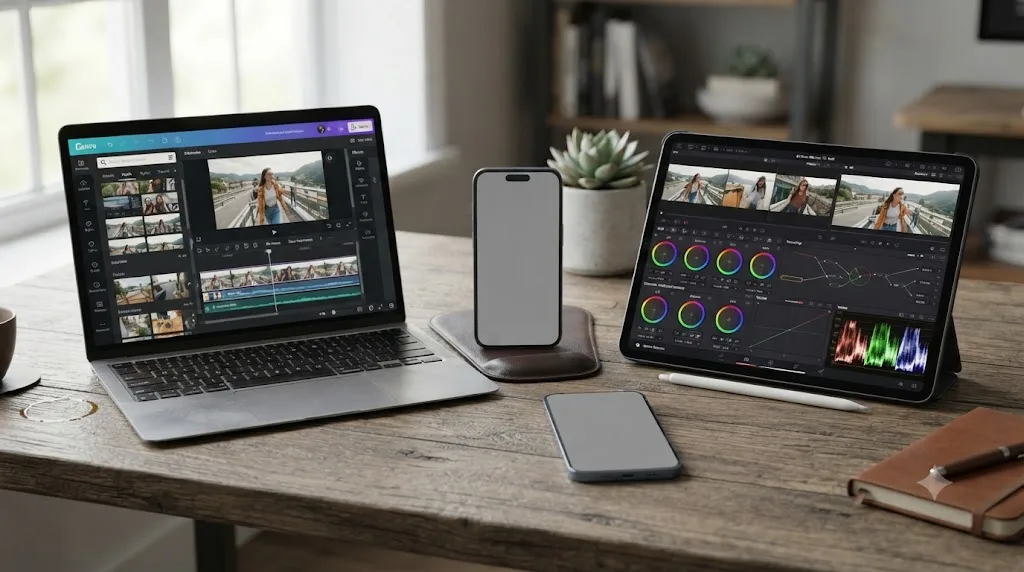
Canva's mobile video editor for iOS and Android carries over most of what the desktop and browser editor does: the same timeline, the same drag-and-drop template system, the same text and transition tools, plus real-time multi-person collaboration built into the phone app itself, according to Canva's own mobile video editor page. You can start a design on a laptop at your desk and finish trimming it on a train, no separate app, no separate account, no feature you have to relearn.
DaVinci Resolve has no phone app at all, on either iOS or Android, and never has. What it does have is DaVinci Resolve for iPad, a genuinely separate, free application from Blackmagic Design that runs on iPad only, not on iPhone or any Android tablet. It's not a stripped preview: it runs the real Cut and Color pages, with the same node-based color engine and the same primary grading tools as desktop, per Blackmagic's own iPad system requirements page. What it doesn't carry over is Fusion or Fairlight, so any compositing or serious audio mixing still has to wait for a desktop session. Our full breakdown of whether DaVinci Resolve works on iPad covers device requirements, pricing, and what the app leaves out in more depth.
| Canva | DaVinci Resolve | |
|---|---|---|
| Phone app | Yes, iOS and Android | No, on either platform |
| Tablet app | Yes, same app as phone | iPad only, separate app from desktop |
| Feature parity with desktop | High, same core editing tools | Cut and Color only; no Fusion or Fairlight on iPad |
| Real-time multi-user editing | Yes, built into the mobile app | Not on iPad; desktop-only Collaboration mode |
A beginner who edits mostly from a phone has an easy call here. Canva's mobile app is a first-class citizen of the product, not an afterthought bolted onto a desktop tool. DaVinci Resolve's closest equivalent needs an iPad specifically, and even then hands you half the app. If your editing genuinely happens on a phone more often than a computer, that alone might decide this comparison before color grading or audio ever enters the conversation.
Can multiple people work on the same project at once?
Yes in both tools, but the collaboration model is built on completely different assumptions, and mismatched expectations here cause real friction on a team project.
Canva's collaboration grew directly out of its design-tool roots: multiple people can be inside the same design at the same time, seeing each other's cursors move and edits land live, the same real-time model behind Google Docs. Comments, mentions, and assigned tasks on specific scenes or elements are part of the same system, according to Canva's mobile video editor page, which documents this real-time multiplayer behavior for the video editor specifically.
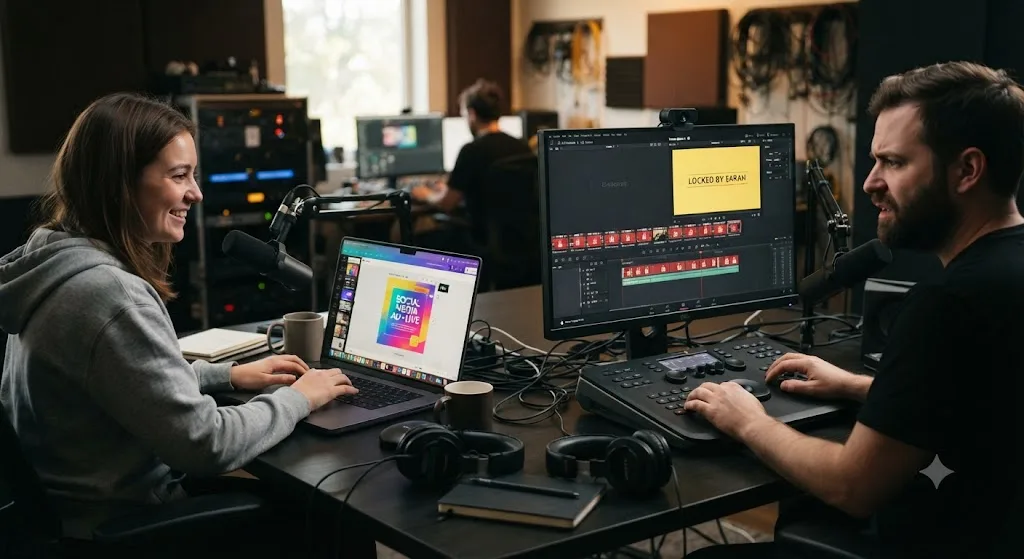
DaVinci Resolve's Multi-User Collaboration works differently on purpose, and it's worth understanding before you assume it behaves like Canva's version. Per Blackmagic's own collaboration page, the system runs on a first-come, first-served lock: whoever opens a bin, a timeline, or a clip first claims it, and everyone else gets read-only access until that person clicks away. It's not simultaneous multi-cursor editing on the same object, it's structured hand-offs that prevent two editors from silently overwriting each other's work on the same timeline. Two people absolutely can work the same project at once, an editor cutting one sequence while a colorist grades a different one, but not the same clip, the same second. And this isn't a paid-tier feature: the free edition includes Multi-User Collaboration too, so a beginner testing this with a friend doesn't need to buy Studio first.
That locking model trips up teams often enough that it has its own well-documented failure mode: opening one timeline can lock every other timeline sharing its bin, not just the one you touched. Our guide to DaVinci Resolve's Collaboration Mode timeline-locked issue walks through why that happens and the one-bin-per-timeline fix that clears it in under a minute.
Canva's collaboration model assumes you're all looking at the same canvas together. DaVinci Resolve's assumes you're each protecting your own piece of a shared project from the others. Neither approach is wrong, they're solving different problems: a marketing team refining one branded video together in real time versus a post-production team where an editor, colorist, and audio engineer each need exclusive control of their own piece without anyone's changes vanishing.
What do professional editors and reviewers actually say?
Worth naming the honest consensus here instead of picking whichever quote flatters the conclusion this guide is already pointed toward.
Danny Maiorca, writing for MakeUseOf about where Canva genuinely holds its own against dedicated editors, is direct about where the professional crowd's attention actually sits: "Canva is rarely mentioned in conversations with professional video editors, who often prefer the advanced features of Final Cut Pro, DaVinci Resolve, and Adobe Premiere Pro" (source: MakeUseOf, Danny Maiorca). That's not a dismissal of Canva; the same piece goes on to name specific areas where Canva genuinely beats pro tools on convenience, mixing template types within one project being one of them. It's a precise claim about where the professional consensus lands, not a blanket verdict either way.
That consensus tracks with what Bassett's Medium review concluded independently, and with the bityclips review's explicit advice to graduate to DaVinci Resolve, Premiere Pro, or CapCut Desktop once a project outgrows Canva's three-minute comfort zone. None of these sources argue Canva is a bad product. What they consistently argue is that Canva earns its reputation on speed and design integration, not on editing depth, and that professional editors reach for it rarely, for exactly the reasons the feature gaps above explain.
On the Resolve side, the honest consensus is just as consistent: real, but temporary friction. Blackmagic Design's own free training curriculum exists precisely because the company knows its software has genuine depth to climb, six structured guides covering editing, color, audio, and visual effects, according to Blackmagic's training page. YouTube channels built around Resolve, Casey Faris among the most consistently recommended for clear, non-hype walkthroughs, spend real time on orientation content specifically because new users need it. Reddit's r/DaVinciResolve is full of beginners asking some version of the exact question this guide answers, and the honest recurring answer there tracks the same line: fine for a single quick clip if you're patient with the first session, clearly worth learning once you're editing regularly or want more than a filter.
Worked example: cutting the same 60-second clip in Canva and DaVinci Resolve
Numbers make this concrete in a way a feature table can't, so here's a realistic walk-through of the same task in both tools: cutting a raw two-minute phone recording down to a 60-second vertical clip, with a caption, a title card, and a music bed.
In Canva, starting from zero prior experience with its video editor: open a blank video design or pick a template (under a minute), upload the raw clip into the design (a minute, depending on connection speed), trim using the timeline's drag handles (a couple of minutes, since the interface makes in and out points obvious immediately), drop in a title card from Canva's template library and adjust the text (two or three minutes), add a stock or uploaded music track and adjust volume (a minute), add captions using Canva's caption tool (under a minute, plus a quick proofread), and export at 1080p if you're on Pro, 720p if you're not (a minute or two). Total: roughly eight to twelve minutes, most of it spent in the template and text-styling steps rather than the cut itself.
In DaVinci Resolve, for someone who has never opened the app before: install and launch (five to ten minutes the first time, essentially zero afterward), import the clip on the Cut page (a minute or two while you locate the Media Pool), trim with the Blade tool or a keyboard shortcut (a couple of minutes once you know it, longer while you're hunting for the button), duplicate the timeline and set it to vertical 1080x1920 in Project Settings (a few minutes the first time, since Project Settings isn't where a Canva user would intuitively look), manually set Scaling to Scale Full Frame with Crop and adjust position (a few minutes on the free edition, since there's no one-tap auto-reframe without Studio's Smart Reframe), build a title using a Text+ template and adjust timing (three to five minutes, more manual than Canva's drag-in templates but far more customizable), add a music track from your own library, since Resolve has no built-in stock-music browser (a few minutes to source and license one), add captions manually or through a third-party plugin if you don't have Studio's Create Subtitles from Audio feature (five to ten minutes), and export from the Deliver page using a built-in platform preset (a couple of minutes). Total for a first-timer: realistically 30 to 40 minutes, most of it spent finding where things live rather than doing the actual edit.
| Step | Canva (first time) | DaVinci Resolve (first time) | DaVinci Resolve (fifth time) |
|---|---|---|---|
| Import footage | Under 1 min | 1-2 min | Under 1 min |
| Trim to length | 1-2 min | 2-3 min | 1 min |
| Convert to vertical | Built into template | 3-5 min (manual crop) | 1-2 min |
| Add title card | 2-3 min (template-driven) | 3-5 min (build from Text+) | 1-2 min |
| Add music | 1 min (Canva stock library) | 3-5 min (source your own) | 3-5 min (no shortcut here) |
| Add captions | Under 1 min (built-in) | 5-10 min (manual or plugin) | 3-5 min |
| Export | 1-2 min | 2-3 min (faster with a preset) | 1-2 min |
| Total | 8-12 min | ~30-40 min | ~11-17 min |
The real question isn't which tool is more capable. It's how many times you're going to open it this month. Eight to twelve minutes, every single time, with a hard ceiling on how far it grows, describes Canva accurately. Thirty-plus minutes once, dropping to under fifteen by clip five, with a huge ceiling to grow into, describes DaVinci Resolve. Neither number is a wrong answer to give. They answer different questions about your own future workload, not about which piece of software is objectively better.
What's the best way to learn DaVinci Resolve fast if you're coming from Canva?
If you've read this far and landed on "I'm editing regularly enough that Resolve's depth is worth the setup cost," here's the fastest realistic path in, not the slowest one a full production course would put you through.
Start on the Cut page, not the Edit page. Its simplified toolset and single-track-first layout sit much closer to the drag-and-drop simplicity Canva already trained you on than Resolve's full multi-track Edit page does. This single decision, Cut page first, is the biggest speed shortcut available to anyone making this exact switch.
Pair that with a narrow, task-specific orientation instead of a full course. Blackmagic's own free training guides are ground truth, written by the people who built the software, and worth a skim for vocabulary and structure, but you don't need all six PDFs before cutting your first clip. YouTube channels built specifically around Resolve, Casey Faris among the most consistently recommended, cover real workflows in short, digestible pieces. Watching just the segment on the Cut page and vertical export gets you further, faster, than a full-course marathon, and Reddit's r/DaVinciResolve is genuinely useful for one specific thing: troubleshooting a single, reproducible error, not answering a broader "how do I learn this" question a thread can't really settle.
Our deeper guide to the best way to learn DaVinci Resolve covers the underlying learning-science reasoning for why guided, in-app practice tends to beat watching a course straight through. It's worth reading if the Canva-to-Resolve switch is genuinely your plan and not just a hypothetical.
None of the free resources above can see your specific project. Blackmagic's guides, YouTube walkthroughs, and Reddit threads all teach a demo clip chosen because it behaves predictably, not your actual footage with your actual framing problem or your actual audio issue. That gap, between a tutorial's sample clip and your real timeline, is exactly what the next section addresses directly.
Is there an AI tool to learn DaVinci Resolve, or an app that helps while you're actually using it?
Yes, and it's worth being precise about which kind of help you actually want, since "AI tool for Resolve" now covers at least two genuinely different products.
TryUncle is the on-screen assistant for DaVinci Resolve on macOS, ask in plain words and Uncle points at the exact control on your screen. It's built for the exact friction point a Canva-to-Resolve switcher hits constantly in that first month: you're mid-clip, you remember Canva had a simple button for this, and you can't find Resolve's equivalent without alt-tabbing to a search engine and typing out a paragraph describing your problem. Uncle watches your Resolve session and points directly at the panel, node, or setting you're asking about, live, inside your own project, on the Edit, Color, and Fusion pages.
That's a different job from a second category of tool now showing up around Resolve: AI agents that execute edits from a typed instruction rather than pointing at a control for you to click yourself. CutAgent, Sottocut, PremiereCopilot, and Eddie AI all read your timeline or transcript and generate a rough cut, a trim, or an assembly from a chat-style prompt. That's genuinely useful if you have hours of footage to turn into clips at real volume and would rather review an AI's rough cut than build the timeline yourself. It's a different bet than TryUncle makes, and it's worth being honest that these execution-focused tools are the ones a general search usually surfaces first.
| Tool | What it does | Touches your timeline for you? | Where it fits |
|---|---|---|---|
| CutAgent, Sottocut, PremiereCopilot, Eddie AI | Execute cuts inside Resolve from a typed or spoken instruction | Yes | Speeds up mechanical cutting once you already know roughly what you want |
| TryUncle | Watches your screen and points at the exact control you're asking about | No | Closes the "where did that setting go" gap while you're still learning Resolve's layout, coming from Canva or anywhere else |
Guided practice inside Resolve beats watching courses about Resolve. That's the whole design premise behind an in-app assistant instead of another tutorial series, and it's especially relevant here: a Canva-to-Resolve beginner already knows what a finished edit is supposed to look like, since Canva taught that part. What's missing is knowing where the equivalent tool lives inside five unfamiliar pages instead of Canva's one. If you're committed to learning Resolve properly, so the skill sticks past this one project, an in-app tutor that points rather than clicks fits that goal better than a tool that does the click for you.
TryUncle is a paid subscription at $39 a month, macOS only, cancel anytime. Check TryUncle directly for the current rate before deciding it fits, since this guide can't guarantee the number stays accurate indefinitely. It's also worth being upfront about the platform limit: if you edit on Windows, TryUncle isn't an option right now, and Canva's browser-based, cross-platform nature is a genuine advantage in that specific case.
Our full roundup of AI tools people actually use to learn DaVinci Resolve covers this category in more depth than this section can, including where ChatGPT and Claude fit into the picture, and our guide to TryUncle for complete DaVinci Resolve beginners walks through a first session end to end.
Common mistakes beginners make choosing between Canva and DaVinci Resolve
Most of the regret in this decision traces back to a handful of avoidable assumptions, not to either tool actually being the wrong pick in the abstract.
Judging DaVinci Resolve by its scariest page instead of the one you'd actually use. New users land on the Color page's node graph or Fusion's compositing canvas by accident and conclude the whole app is too much for a beginner. The Cut page, the one you'd actually use first, looks nothing like that.
Assuming Canva's video features are "good enough" without checking the specific gap that matters to your project. If your project needs one thing Canva structurally can't do, chroma key, real multi-track audio, or footage longer than a few minutes, no amount of Canva Pro's extra templates fixes that, since none of the paid tiers add those capabilities.
Picking Canva for a workload that's actually multi-output. If you're repurposing longer recordings into several clips a week, as covered above, Canva's per-clip speed advantage doesn't offset the lack of any shared organizational system connecting those clips back to one source.
Assuming DaVinci Resolve's Collaboration mode works like Canva's real-time multiplayer. Teams that expect simultaneous, same-clip editing get confused the first time a bin comes back read-only, and blame it on a bug rather than the deliberate first-come lock model covered above. Learn the lock behavior, and give each active timeline its own bin, before a shared project's deadline forces you to learn it the hard way.
Assuming DaVinci Resolve's free edition is more limited than it actually is. A surprising number of beginners assume they need the $295 Studio license just to do basic cutting and a simple color pass. They don't; the free edition includes full Color, Fairlight, and Fusion access, with the paywall affecting export resolution above Ultra HD and a specific set of AI and collaboration extras most beginners won't touch for months, if ever.
Treating this as a permanent, one-tool-forever decision. Plenty of creators reasonably use both: Canva for branded templates, thumbnails, and quick marketing assets, DaVinci Resolve for anything needing real editing depth. Picking one tool forever isn't required.
| Mistake | What actually happens | Fix |
|---|---|---|
| Judging Resolve by Color or Fusion | Concluding the whole app is overkill from the scariest page | Start on and judge from the Cut page specifically |
| Assuming Canva Pro adds editing depth | Paying $14.99/mo for templates while still lacking color and audio tools | Confirm what Pro actually adds: design assets and export resolution, not editing features |
| Choosing Canva for a multi-output weekly workload | Losing the organizational benefit of Resolve's markers and shared project | Match the tool to whether you're cutting one clip or several from one source |
| Expecting Resolve's Collaboration mode to work like Canva's | Getting locked out of a bin mid-deadline and assuming it's broken | Learn the first-come lock model and give each active timeline its own bin |
| Assuming free Resolve is too limited | Paying $295 for Studio before it's actually needed | Confirm what's paywalled: resolution ceiling and AI extras, not core editing |
| Treating the choice as permanent | Sticking with a worse-fit tool out of habit | Use both, per project, without treating it as a loyalty decision |
Can you use Canva and DaVinci Resolve together instead of choosing one?
Yes, and this is worth naming directly because most comparisons force a false either-or that doesn't match how a lot of creators actually work.
A common hybrid workflow looks like this: build branded title cards, lower-thirds, thumbnails, and intro graphics in Canva, where the template library and Brand Kit tools do real work fast, then export those elements as transparent PNGs or short video clips and bring them into DaVinci Resolve. Resolve handles the actual cut, the color pass, the audio mix, and the final export, compositing Canva's graphics on top of the timeline like any other layer.
This plays to each tool's actual strength instead of asking either one to do a job it wasn't built for. Canva's design library and brand consistency tools have no real equivalent inside Resolve, since Resolve was never trying to be a graphic design platform. Resolve's color, audio, and multi-track depth have no equivalent inside Canva, for the same reason in reverse. Neither tool needs to be the only tool in your workflow just because this article compared them head to head.
The practical requirement on the Canva side: export your graphic as a transparent-background PNG (for a static title) or an MP4 with an alpha channel if your Canva plan supports it (for an animated element), then import that file into Resolve's Media Pool like any other clip and place it on a track above your footage. That single habit turns Canva from a competitor into a genuinely useful part of a Resolve-based pipeline, for exactly the branded, templated work Canva already does well.
DaVinci Resolve vs Canva: the full side-by-side comparison table
Here's every row from this article in one place, so you don't have to scroll back through each section to compare two specific features.
| Feature | Canva | DaVinci Resolve |
|---|---|---|
| Price (free tier) | Free, 720p export, watermark on some features | Free, no watermark, Ultra HD export |
| Price (full-featured) | $14.99/mo, ~$6.50/mo annual (Pro) | $295 one-time (Studio) |
| Platform | Browser-based, plus desktop app; needs internet | macOS, Windows, Linux; works fully offline once installed |
| Phone or tablet app | Yes, full-featured, iOS and Android | iPad only (Cut and Color pages), no phone app |
| Timeline editing | Yes, drag-and-drop, multiple video tracks | Yes, frame-accurate, multi-track |
| Templates and stock library | 610,000+ templates, 100M+ stock assets (Pro) | None built in; Power Bins for your own reusable assets |
| Color grading | Basic filters only | Node-based Color page, curves, wheels, scopes |
| Audio editing | Volume slider, automated noise removal | Fairlight, full multi-track DAW |
| Chroma key / compositing | Not available | Built into Fusion, 250+ tools |
| Keyframe animation | Not available | Full keyframe control on Edit and Fusion pages |
| Export control | Resolution only | Format, codec, bit rate, resolution, frame rate |
| Max video file size | 1GB per file | No fixed application-level cap |
| Team collaboration model | Real-time, multi-cursor, same canvas | First-come lock, one editor per bin/timeline/clip |
| Best learning curve, hour one | Canva | - |
| Best learning curve, month one | - | DaVinci Resolve |
| Offline editing | No | Yes |
| Free official training | Limited | Six free guides plus video library (Blackmagic) |
So which one should you actually pick?
If you strip away the brand familiarity Canva already has from your design work, the decision comes down to one honest question: are you making a single branded clip, or are you learning to edit video?
If it's a single branded clip, matching a template, a brand kit, and other marketing assets you've already built in Canva, open Canva. It's faster, it's free at 720p, and it's genuinely built for exactly that job. Don't install a seven-page production app to make one fifteen-second post.
If you're editing regularly, want real color control, need more than one music track under your voice, or expect this to be the first of many projects rather than a one-off, DaVinci Resolve's free edition is the better long-term investment, and it costs nothing to find out. The tool that's free forever beats the tool that's free until you need the one feature it doesn't have. Start on the Cut page, budget one real session for your first clip, and expect that time to drop by more than half within four or five clips.
Neither app is a downgrade from the other. They're built around different bets on what most of your time will actually go toward, and both bets are defensible. Pick based on the specific project sitting in front of you this week, not on which tool you already have a login for, and if that project points you toward Resolve, treat the first hour of relearning where things live as the real cost of the switch, not a footnote you'll figure out later.
Frequently asked questions
- Is DaVinci Resolve better than Canva for beginners?
- It depends on what 'beginner' actually means for you. If you're making one quick, templated social clip and want it posted in minutes, Canva's simpler surface wins. If you expect to keep editing regularly, want real color control, or need more than a single music track, DaVinci Resolve's free edition gives you all of that at no cost, and the extra first-session learning curve pays for itself by your third or fourth clip.
- Can Canva actually edit video, or is it just for graphic design?
- Canva genuinely edits video now, with a real timeline, clip trimming and splitting, transitions, and text animation, not just static graphics with motion added on top. What it still lacks, according to 2026 reviews of the tool, is chroma key compositing, keyframe animation, multi-track audio mixing, and any color grading beyond basic filters, the features that separate a design tool with a timeline from a dedicated video editor.
- Is DaVinci Resolve too hard for someone who has never edited video before?
- It's demanding on day one because it's actually five specialized applications (Edit, Cut, Color, Fairlight, Fusion) behind one set of page tabs, and a first-timer will spend real minutes just finding where things live. It is not too hard to become comfortable with, though; starting on the simplified Cut page instead of the full Edit page, and pairing it with Blackmagic's own free training, gets most beginners through a first project in under an hour.
- Is Canva Pro worth paying for if I mainly want to edit video?
- Only if templates, stock footage, and Canva's design library matter more to you than editing depth. Canva Pro adds 1080p exports, background removal, and premium stock assets, but it still doesn't add chroma key, multi-track audio, or real color grading. DaVinci Resolve's free edition already includes all three of those at no cost, which makes Canva Pro a design-library upgrade, not a video-editing upgrade.
- What's the best way to learn DaVinci Resolve fast if I'm coming from Canva?
- Skip the Edit page at first and start on the Cut page, which is built for fast, low-friction assembly close to what Canva's drag-and-drop timeline already feels like. Pair one short orientation video from Blackmagic's own free training or a channel like Casey Faris with cutting your own footage immediately, rather than a demo clip that behaves nothing like your actual project.
- Is there an AI tool to learn DaVinci Resolve, or an app that helps while you're actually using it?
- Yes. TryUncle is the on-screen assistant for DaVinci Resolve on macOS, ask in plain words and Uncle points at the exact control on your screen, live, inside your own project on the Edit, Color, and Fusion pages. That's a different job from tools like CutAgent or Eddie AI, which execute cuts for you; TryUncle doesn't touch your timeline, it just shows you where the thing you need actually lives.
- Can I use Canva and DaVinci Resolve together instead of choosing one?
- Yes, and plenty of creators do exactly that. A common workflow is designing branded title cards, thumbnails, or lower-third graphics in Canva, exporting them as transparent PNGs, and importing them into DaVinci Resolve to composite over the timeline. Canva stays in the design lane it's actually built for, and Resolve handles the cut, color, and audio.
- Can I use DaVinci Resolve on my phone the way I can use Canva on mine?
- No. DaVinci Resolve has no phone app on iOS or Android, so if your workflow happens mostly on a phone, Canva's mobile app is the only one of these two tools built for that. DaVinci Resolve does have a separate, genuinely capable iPad app, but it only covers the Cut and Color pages and needs an iPad specifically, not an iPhone. Canva's mobile app, by comparison, carries over nearly everything the desktop editor does, plus its real-time collaboration features, on both iPhone and Android.
Sources
- Canva Video Editor Review 2026: Timeline Editing, Free vs Pro, and Where It Falls Short (fluxnote)
- Canva Video Review 2026: Best Design-First Video Tool? (bityclips)
- What is the Video Limit on Canva? The Essential 2026 Guide (techradar.info)
- Canva Video Editor Review: Fun & Easy...But Limited, by Erik Bassett (Medium)
- Canva Has These 5 Video Features, Pro Editors Don't, by Danny Maiorca (MakeUseOf)
- Canva pricing (Canva)
- Download our free video editing app on mobile (Canva)
- DaVinci Resolve - Studio (Blackmagic Design)
- DaVinci Resolve (Blackmagic Design product page)
- DaVinci Resolve Training (Blackmagic Design)
- DaVinci Resolve - Collaboration (Blackmagic Design)
- DaVinci Resolve for iPad (App Store, Apple)
- DaVinci Resolve Download (Blackmagic Design, system requirements)
- In Depth: DaVinci Resolve Studio vs Free (Updated for 21) (Toolfarm)
- DaVinci Resolve System Requirements for Windows, macOS, and Linux (CodeItBro)
- Level Up Your Editing Skills With Blackmagic's Beginner's Guide to DaVinci Resolve 19 (No Film School)
- CutAgent (product site: features, pricing, FAQ)
- Sottocut (product site)
- PremiereCopilot pricing
- Eddie AI for DaVinci Resolve (native integration workflow page)
- TryUncle
- TryUncle FAQ
Learn by doing, not watching
Stop translating tutorials to your timeline.
TryUncle stays beside Resolve on Mac and Windows. When you ask, Uncle sees your screen and points at the exact control you need. No hunting through tabs, timestamps, or mismatched tutorials.
Meet TryUncleKeep reading
 GuidesJul 19, 202638 min read
Is DaVinci Resolve Overkill for Simple Social Media Edits?
A quick TikTok or Reel trim doesn't need DaVinci Resolve's seven pages. Here's when it's overkill, when it isn't, and how it stacks up against CapCut.
 ComparisonsJul 11, 202626 min read
The Best AI Tools to Learn DaVinci Resolve in 2026
ChatGPT, Claude, Blackmagic's free training, Recut, and Resolve's Neural Engine compared for learning DaVinci Resolve, and the gap none of them close.
 GuidesJul 12, 202641 min read
The Best Way to Learn DaVinci Resolve (What the Research Says)
Guided, hands-on practice inside DaVinci Resolve beats video courses and MOOCs. Here's the learning-science research behind why, and how to apply it.