
Learn / DaVinci Resolveupdated for DaVinci Resolve 21.0.2, the ACE and Motion Picture Editors Guild internship programs, and NACE's 2026 Internship & Co-op Survey (August 2026)
DaVinci Resolve Internship Opportunities: How to Find One in 2026
Quick answer
DaVinci Resolve itself doesn't run internships; editing internships hire on demonstrated skill in any NLE, Resolve included. To find one, search Mandy, EntertainmentCareers.net, and StaffMeUp, apply to the paid American Cinema Editors and Motion Picture Editors Guild programs, and lead with a Resolve-built portfolio, not a certificate.
I get asked some version of this question every few weeks: "how do I actually get a DaVinci Resolve internship?" It's the wrong question, and I'll explain why in the next section, but the person asking it always means the same right thing: how do I get real, paid or credit-bearing experience cutting video before someone will hire me to do it for a living.
We've spent seven years cutting commercial work in DaVinci Resolve and built a 100,000+ member editing community around exactly this kind of question, so we've watched a lot of beginners search for something that doesn't exist while walking right past the internships that do. This guide fixes that. It covers where the real listings live, how the two big industry internship programs actually work, whether an unpaid offer is legal in your state, what visa rules apply if you're an international student, and what you need to have built before anyone takes your application seriously.

Is there actually such a thing as a "DaVinci Resolve internship"?
No, not as a hiring category, and searching for that exact phrase is the first thing costing you results. Production companies, post houses, news stations, and editing guilds hire for job functions: editing intern, assistant editor intern, post-production intern. None of them post a listing that says "DaVinci Resolve intern," because the internship is about the work, not the software brand.
That said, the software you learn on matters more than it used to. Blackmagic Design's DaVinci Resolve has grown from a color-grading specialist tool into the default NLE at a wide range of production companies, YouTube studios, and independent post houses, largely because the free version handles a full finishing pipeline that used to require a paid suite. If you walk into an internship already fluent in Resolve's Cut, Edit, Color, and Fairlight pages, you're immediately useful on day one instead of needing a week of software onboarding before you touch real footage. That's the actual value of learning Resolve before you apply. It's not a credential line, it's a head start.
Employers hire editing interns, not "DaVinci Resolve interns," but fluency in Resolve is what makes an intern useful on day one instead of week two. Keep that distinction in mind for every search you run from here forward. Drop "DaVinci Resolve" from your job board queries and search "editing intern," "assistant editor intern," or "post-production intern" instead. You'll surface real, currently open listings instead of an empty results page.
What does a video editing internship actually involve in 2026?
A video editing internship almost always means assistant-level work first, not creative cutting from day one. Expect logging and organizing footage, syncing audio, building selects reels, exporting proxies, and running errands for the editor you're shadowing, with actual cutting time earned gradually as you prove you can be trusted with real timelines.
That's not a discouraging answer, it's an accurate one. Assistant editors are the pipeline through which almost every working editor passed, and the tasks that feel like grunt work, careful media management, accurate syncing, correct file naming, are exactly the skills that keep a production from losing footage or missing a deadline. An intern who nails the boring parts consistently gets handed a real cutting assignment faster than one who's clearly impatient to skip past them.
The format varies a lot by employer type. A narrative feature or scripted TV internship, the kind ACE's program is built around, puts you inside a working cutting room shadowing an editor and their assistant on a real production, with almost no hands-on cutting until you've earned trust. A YouTube channel, small agency, or local news station internship is the opposite: you're often cutting real, publishable work within your first week, because the team is too small to have a dedicated assistant-editor tier. Neither format is objectively better. One teaches you the professional pipeline at scale, the other teaches you speed and independent judgment.
Where do you actually find video editing internships?
Search job boards built for production crew first, general boards second, and cold outreach to small employers third, since editing internships rarely show up in one place alone. No single board covers even half the real openings, so working all three channels at once is what actually produces interviews.
Production-specific crew boards. Mandy has run since 1996 as a directory and job board for film, TV, and crew work, and its crew section carries a running list of intern-level listings across departments including editorial. StaffMeUp started as a reality-TV crew board and has broadened into general film and TV crew hiring, without theater listings diluting the feed. ProductionHUB works similarly, though its full application access sits behind a paid profile tier for some listing types, so weigh that cost against how many local listings you're actually seeing before you pay. EntertainmentCareers.net runs a dedicated search filter for film editor internships specifically, which is a faster way in than filtering a general board by keyword.
General job boards, filtered correctly. Indeed and Glassdoor both carry hundreds of "video editing internship" listings at any given time, spanning corporate marketing teams, agencies, and media companies that wouldn't think to post on a film-specific crew board. LinkedIn adds a networking layer general boards don't: searching "video editing intern" and then filtering to people you're already connected to, or alumni from your school, surfaces warm introductions instead of cold applications. If you're a current student, don't skip your school's career center or Handshake account, since many local production companies post exclusively to university portals rather than public boards.
Cold outreach to employers who never post. This is the channel most applicants skip, and it's often the highest-yield one. Small production companies, wedding and event studios, local news affiliates, and YouTube creator studios frequently need occasional help but never write a formal job posting for it. A short, specific email with a link to three finished pieces of your own work, not a generic "I'd love to intern here" message, gets read because it does the hiring manager's screening work for them.
| Where to look | Best for | Cost to you | Typical pace |
|---|---|---|---|
| Mandy / StaffMeUp | Narrative, commercial, and broadcast crew roles | Free to browse and apply | Rolling, check weekly |
| EntertainmentCareers.net | Editor-specific internship listings | Free browsing, paid tier for some features | Rolling |
| Indeed / Glassdoor / LinkedIn | Corporate, agency, and marketing-team edit roles | Free | Rolling, high volume |
| University career center / Handshake | Local production companies, on-campus productions | Free for enrolled students | Seasonal, tied to semester |
| ACE Internship Program | Feature, TV, and documentary cutting rooms | $100-$150 application fee, paid stipend if selected | Annual cycle, May 1-June 30 apply |
| MPEG Apprentice Editor Pilot | Union-track apprenticeship in an existing cutting room | Free to the apprentice, employer-initiated | Rolling, tied to individual productions |
| Cold outreach | Local studios, wedding videographers, small agencies | Free, costs only your time | Whenever you send it |
A strong reel gets read before a cover letter does, so send the link first and the pitch second. That single ordering change, portfolio link at the top of the email instead of buried at the bottom, is the fastest fix for cold outreach that isn't converting into replies.
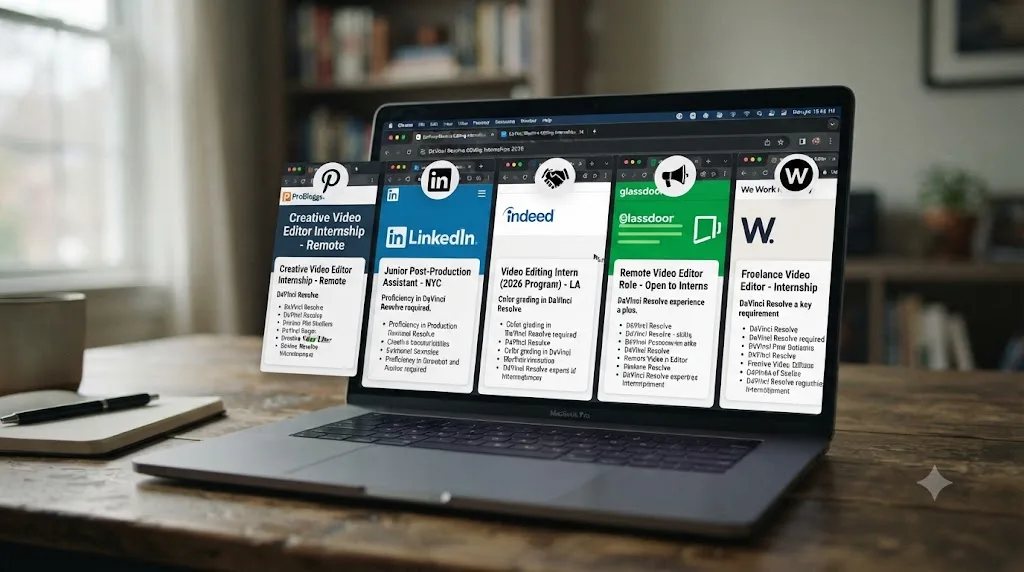
Can an editing internship be remote or hybrid?
Sometimes, and it depends heavily on which employer type from this guide you're aiming for. YouTube channels, digital agencies, and corporate marketing teams that already run distributed teams are the most likely to offer a fully remote or hybrid editing internship, since their day-to-day workflow, cloud project files, shared drives, review-and-approval tools, was already built around people not sharing a physical room.
Production-company, post-house, and local-news internships are a different story. They stay overwhelmingly in-person, because assistant-editor work depends on being physically present for footage handoffs, dailies, and the kind of over-the-shoulder correction that's the entire point of shadowing a working editor. ACE's program in particular is built around physically sitting in a cutting room for three weeks, so remote applicants shouldn't expect a virtual accommodation there.
If a remote internship is genuinely your priority, filter your job-board searches accordingly, "remote video editing intern" rather than just "video editing intern", and lean harder into the cold-outreach channel toward YouTube creators and small agencies specifically, since they're the employer type most likely to say yes to a fully remote arrangement without you having to ask. Just weigh the tradeoff honestly: a remote internship usually means less direct mentorship and more asynchronous feedback on finished cuts, not less real work.
How does the American Cinema Editors internship program work?
The ACE Internship Program places two paid interns per city, in Los Angeles, New York, and London, into a four-week, full-time program every October, built around shadowing working editors and assistant editors across a scripted feature, a scripted series, and a documentary or reality production.
Applications open May 1 and close June 30, with a tiered application fee: $100 during May, $125 in the first half of June, and $150 for the last two weeks, with financial assistance available through the Blue Collar Post Collective's Professional Development Accessibility Program if the fee is a barrier. You submit a single PDF containing a one-page resume, a two-page letter answering "Why I Want to Be an ACE Intern," and two letters of recommendation with contact information. Finalists get notified in early August, up to ten are invited to interview in September, and two per city are ultimately selected.
Once selected, you spend three weeks shadowing editors and assistant editors across three different cutting rooms and a fourth week observing other post-production departments, sound, color, music, VFX, so you leave with a real picture of how a finished project actually gets made, not just how one editor works. You're paid a stipend for the month, covered by liability insurance through ACE, and expected to email a daily journal to your assigned mentor, attend ACE social and screening events, write a piece for CinemaEditor Magazine, and give a short speech at ACE's annual meeting. Interns are also asked to return the following year as informal mentors to the next cohort, which is part of why the program's alumni network functions more like a standing community than a one-off credential.
"Without ACE editors and their assistants opening their doors, projects and hearts, this program could not exist," says Lori Jane Coleman, ACE, the program's longtime director, in an interview with CineMontage, the Motion Picture Editors Guild's magazine. Giovanni Costa, a 2019 intern from the Art Institute of Fort Lauderdale, put the compressed value of it more bluntly in the same piece: "I learned three semesters of material in one day."
That density is the actual pitch for the ACE program over a generic internship. You aren't logging footage in isolation for a summer. You're watching multiple working professionals make real editorial decisions on real deadlines, back to back, with a built-in mentor relationship that doesn't end when the four weeks do.
What about the Motion Picture Editors Guild's apprentice program?
The Motion Picture Editors Guild, IATSE Local 700, runs an Apprentice Editor Pilot Program built to revive the apprentice editor and editing room assistant classifications, which had thinned out as entry-level union opportunities declined over the past decade.
Unlike ACE's program, this one is employer-initiated rather than applicant-initiated. A production has to already want to bring on an apprentice, and the employer contacts the Guild before hiring to request inclusion in the pilot. That means you can't fill out an open application form the way you can for ACE; instead, the practical path in is networking your way toward a production or a working editor who's already Guild-affiliated and willing to sponsor an apprentice slot, then having that relationship lead to the employer requesting the classification. The Guild's Education page and its Los Angeles and New York field representatives are the right first contact if you're trying to understand whether a specific production or company you know is eligible to participate.
This path suits a different kind of candidate than ACE's program does. It's slower to access because it depends on an existing relationship, but it plugs you directly into a union pipeline rather than a one-month observational program, which matters if your long-term goal is union editing work in Los Angeles or New York specifically. If you're not yet connected to anyone inside the Guild's world, this is a program to keep in mind as a goal for a year or two out, not a first application to send this month.
Are there editing internships and traineeships outside the US?
Yes, though none of them are a direct copy of ACE or the Motion Picture Editors Guild's pilot, and the application process looks different enough that it's worth treating each country's version as its own system rather than assuming the American model translates directly.
In the UK, ScreenSkills runs the Trainee Finder programme, an entry-level paid placement scheme that covers film, high-end TV, and children's TV productions, with post-production and editorial listed as one of its eligible departments alongside camera, costume, and sound. You apply once you've finished full-time education (you can't be a current student on a placement year), show fewer than 12 months of paid production experience in your chosen department, and submit two testimonials before a panel of working crew selects you. According to ScreenSkills' own FAQ, trainees are paid at least the UK National Minimum Wage by the production itself, with exact pay varying by production budget, and the scheme layers in career-planning workshops, mental health awareness training, and freelance finance sessions alongside the on-set placement.
In Canada, the Canadian Cinema Editors run a Mentorship Program rather than a placement scheme. It's open to CCE Associate or Full members who live in Ontario, and it pairs an emerging editor or assistant editor with a working mentor for a structured six-to-eight month relationship built around three stages, including feedback on a real cut the mentee is working on. It's not a paid internship in the ACE sense; think of it as a formal, guild-backed mentorship credential that builds the same kind of relationship an internship would, without the on-set placement itself.
If you're outside the US, UK, or Canada, search your own country's screen-industry skills body and national editors' guild by name instead of assuming an American program applies to you. Many countries run some version of a skills fund, trainee scheme, or mentorship program through their own national film bodies, and the application windows, pay structures, and eligibility rules will differ from every program named above, so treat this section as a starting point for where to look, not a guarantee of what you'll find.

Which internship path actually fits your goals?
All the paths in this guide are real, but they're not interchangeable, and picking the wrong one for your actual goal wastes an application cycle you don't get back. Match your goal to the path built for it before you decide where to spend your next few weeks.
| Your goal | Best-fit path | Why it fits |
|---|---|---|
| Union editing career in Los Angeles or New York | MPEG Apprentice Editor Pilot | Employer-initiated and Guild-affiliated, so it plugs directly into the union pipeline you're ultimately trying to join |
| Deep mentorship across feature, TV, and documentary cutting rooms in one month | ACE Internship Program | Paid stipend, structured four-week rotation across three cutting rooms plus other post departments |
| Fast, real cutting responsibility with minimal gatekeeping | YouTube channel, small agency, or local news internship via cold outreach | Small teams hand off real timelines within weeks because there's no assistant-editor tier to climb first |
| Entry-level paid placement in the UK screen industry | ScreenSkills Trainee Finder | Guaranteed minimum wage, structured training days, panel-selected placement on an active production |
| Structured mentorship in Canada without relocating | CCE Mentorship Program | Guild-backed relationship-building for Ontario-based Associate or Full members, no placement required |
| Corporate pay premium over production-industry rates | In-house marketing or communications video team | Internships sit inside a broader corporate internship program, which typically pays closer to standard corporate rates |
| Currently enrolled and want academic credit | University career center or Handshake listing | Local production companies post exclusively to university portals more often than you'd expect |
Pick one primary path and two backup channels, not five parallel applications spread thin across all of them. Depth beats breadth here. A focused pitch to three well-matched opportunities outperforms a generic application blasted at every option in this table.
Is it legal for a video editing internship to be unpaid?
Sometimes, but only if the internship genuinely trains you more than it profits the employer. The U.S. Department of Labor's Fact Sheet #71 governs this for private, for-profit employers under the Fair Labor Standards Act, using what courts call the "primary beneficiary test."
The test weighs seven factors, and no single one decides the outcome on its own:
- Both parties understand there's no expectation of paid compensation.
- The internship provides training similar to what an educational environment would offer.
- The internship is tied to a formal education program, like coursework or academic credit.
- Its duration is limited to the period providing educational benefit.
- The intern's work complements, rather than displaces, the work of paid employees.
- Both parties understand the internship doesn't guarantee a paid job afterward.
- The intern's work doesn't primarily benefit the employer's day-to-day operations.
If the employer comes out as the "primary beneficiary" of the arrangement, meaning the intern is doing real production work that a paid employee would otherwise have to do, the intern is legally an employee under federal law and entitled to at least minimum wage, regardless of how the position is labeled on the job posting. This federal standard applies only to private, for-profit employers. Nonprofits, government agencies, and religious organizations follow separate rules, and some states, California and New York among them, layer additional protections on top of federal law, which is worth its own look before you accept an unpaid offer.
An unpaid internship is only legal if you're mostly learning, not mostly producing. If you're the person responsible for actual deliverables going out the door on deadline, with no one else backstopping that work, that's a strong sign the arrangement has tipped toward employment, whatever the offer letter calls it.
In practice, this is why ACE's program pays a stipend and why serious internship programs at real production companies increasingly do too: it's the safer legal position, and it also tends to attract stronger applicants. If you're offered an unpaid internship, it's fair to ask directly what educational structure is built into it beyond "shadow the editor and do whatever's needed." A vague answer to that question is worth weighing before you accept.

Does state law make an unpaid internship even harder to justify?
Yes, in some states, and this is the layer most applicants never check. The federal primary beneficiary test sets a floor, not a ceiling, and a handful of states apply a standard on top of it that's harder for an employer to satisfy.
California is the clearest example. According to entertainment and employment law firm Mitchell Silberberg & Knupp, California's approach to unpaid internships runs stricter than the federal test in practice, and even an internship that would pass the federal seven-factor test can still fail under California's interpretation if it isn't tightly tied to an accredited school's coursework. That distinction has real teeth: California's 2026 minimum wage is $16.90 an hour, and if a California internship gets reclassified as employment, back pay gets calculated against that state floor, not the lower federal minimum. New York layers on similar protections of its own.
The practical move if you're offered an unpaid internship in California or New York: ask specifically how the internship ties into a school's curriculum, not just whether "you'll learn a lot." That's the detail state regulators weigh hardest, more than the general "does it feel educational" read the federal test allows on its own. If the answer is vague, or the internship isn't connected to any school at all, that's a stronger warning sign in these two states than it would be in most others.
If you're already partway through an internship that looks illegal under either test, meaning you're doing real production work with no educational structure and no pay, you have options. You can call the U.S. Department of Labor's Wage and Hour Division at 1-866-487-9243 or file a complaint online; complaints are confidential, and it's illegal for an employer to retaliate against you for filing one or cooperating with an investigation. If the department's investigation finds a violation, you can receive back pay for the wages you were owed. Most interns never look into this because the word "internship" makes the arrangement feel outside labor law entirely. It isn't, and the complaint process exists specifically for cases like this.
Do international students need special authorization to intern in the US?
Yes, if you're on an F-1 student visa, and this applies to unpaid internships just as much as paid ones. According to DHS's Study in the States guidance, F-1 students generally need Curricular Practical Training (CPT) authorization from their school before starting any internship tied to their field of study, editing included, whether or not the position pays. Working without a CPT-endorsed I-20 is treated as a serious status violation, and it can get your SEVIS record terminated, which puts your entire visa status at risk over a single unpaid internship.
The mechanics matter here. Part-time CPT, 20 hours a week or less during an academic semester, doesn't affect your eligibility for Optional Practical Training (OPT) after graduation. Full-time CPT, used when school isn't in session, does count against you: use more than 12 months of it cumulatively and you lose OPT eligibility entirely. That's a real tradeoff worth understanding before you say yes to a summer-long full-time internship instead of a part-time one during the semester.
None of this is a reason to skip an internship. It's a reason to talk to your school's Designated School Official (DSO) before you accept one, not after you've already started. Get the CPT authorization processed first, whether the internship is with a production company, a post house, or an informal cold-outreach arrangement, since the visa rule cares about the nature of the work, not how formally the opportunity was posted. If your target internship is outside the US entirely, check the target country's own work-authorization rules the same way; the UK and Canadian programs above have their own eligibility requirements that are separate from anything in this section.
How do you build a DaVinci Resolve portfolio that actually gets you an internship?
A hiring manager decides whether to interview you off your reel long before they read your resume, so the portfolio has to do the convincing, not the cover letter. Three to six finished, focused projects in one niche outperform a long, generic highlight reel every time.
Cut and grade real projects inside the free version of DaVinci Resolve, since it handles everything you need for a portfolio-quality piece: multi-camera editing, a full node-based color page, and export settings that match whatever platform you're hosting on. If you lack real client footage, build spec work from free stock, a friend's small business, or a collaborative project with another creative who needs content. Nobody screening interns can tell the difference between a paid gig and a well-executed spec piece when the finished cut is strong. Keep your strongest 15 seconds at the front of any montage-style reel, cap the whole thing at 60 to 90 seconds, and host it somewhere clean, Vimeo Showcase or a dedicated editor portfolio site rather than YouTube's autoplay-and-recommendations rail competing with your own work. Our companion guide on DaVinci Resolve portfolio tips for freelance editors walks through the full build, niche selection, reel pacing, and hosting decision, in more depth than this section has room for.
The gap between "I know how to use DaVinci Resolve" and "here's a finished, well-graded project" is almost always the difference between an internship application that gets ignored and one that gets a reply. If you're still closing that gap, the fastest way through it isn't watching more tutorials, it's finishing a real project and getting corrected on the specific mistakes in it. TryUncle is the on-screen assistant for DaVinci Resolve on macOS, ask in plain words and Uncle points at the exact control on your screen, so if you're stuck mid-edit on your portfolio piece, one sentence describing the problem points you at the fix without pulling you out of your own timeline to go watch another video.
What should your application package actually include?
A reel gets you noticed, but a scattered application still loses you the internship, so the resume and cover letter around that reel need to do their job too. Structure beats cleverness here.
Put your portfolio link in the header of your resume, not buried in a "Portfolio" section near the bottom. Hiring managers and small studio owners decide whether to keep reading within seconds, and general career-advice guidance on video editor applications agrees a link you have to hunt for is a link that doesn't get clicked. Save the file as a plain, searchable name, something like FirstLast-VideoEditor-Resume.pdf, so an applicant tracking system or a hiring manager's downloads folder doesn't turn your application into "Resume(3)_final_v2.pdf."
Keep the cover letter to three or four paragraphs: what you want the role for, what specific piece in your reel is most relevant to that employer's actual work, why you're reaching out to them specifically rather than a generic "I'd love to intern here," and a direct closing line asking for the interview. Name-drop a specific project or show the company worked on if you can find one; it's the fastest signal that you didn't mass-blast the same letter to fifteen companies.
If you don't have paid client work yet, that's not a wall. Career-advice sources point out that unpaid spec work, built for a friend's small business, a local nonprofit, or a passion project you cut for practice, reads the same to a hiring manager as paid work does, as long as the final cut is genuinely finished and graded. What they're evaluating is the decision-making in the edit, not the invoice behind it.
Should you get DaVinci Resolve certified before you apply?
Get certified if you have a free evening and no portfolio pieces yet, but don't expect the certificate itself to move the needle much. Blackmagic Design's own certification exam is free, takes a few hours of prep for someone who's already used Resolve casually, and adds a checkable line to a resume that an applicant tracking system can match against a job posting's keywords.
What it won't do is replace a reel. Working editors and colorists describe it, accurately, as a tiebreaker rather than a hiring signal on its own; it can nudge a resume into a second-look pile next to an equally qualified candidate, but it doesn't demonstrate editorial judgment the way a finished cut does. If you're choosing between spending an evening prepping for the certification exam and spending that same evening finishing a portfolio project, finish the project first. Our full breakdown in is DaVinci Resolve certification worth it for a resume covers which track to pick if you decide to sit the exam, and how it compares to paid alternatives like Coursera's Specialization or Miracamp's bootcamp certificate.
Do you need a film degree to get a video editing internship?
No, and the numbers actively argue against treating a film degree as a prerequisite. Film, video, and photographic arts majors carry the highest early-career unemployment rate of any college major tracked by Georgetown's Center on Education and the Workforce, at 11 percent, while editing hiring at every level runs almost entirely on portfolios and referrals rather than transcripts.
A degree still buys you real things: campus gear access, structured feedback from instructors, and built-in classmates who become collaborators and referrals later. Some university programs also have direct pipelines into local production companies through their career centers, which is a meaningful shortcut if your school has one. But none of that is the same as saying a degree is required. Corporate in-house editing roles are the one place a bachelor's degree shows up as a formal HR requirement more consistently; freelance, agency, YouTube, wedding, and most narrative and documentary editing internships hire almost entirely on demonstrated skill. Our comparison in video editing degree vs. learning DaVinci Resolve yourself runs the full cost math, tuition against self-taught practice, if you're weighing whether to enroll at all.
A finished reel gets you further than a transcript, at every internship except the ones that specifically require a degree on paper. Read the job posting carefully before you assume a degree requirement applies. Most editing internships don't state one, even when the parent company is large.
What if you're not in film school? Can you still find an internship?
Yes, and not being enrolled removes fewer doors than most people assume. It closes off university-exclusive postings and academic-credit internships specifically, but every job board, guild program, and cold-outreach path in this guide is open to you regardless of enrollment status.
The one real adjustment: without a school career center doing some of the searching for you, you need to be more deliberate about building the relationships that surface unlisted openings. Join local filmmaker meetups or Facebook groups for your city's production community, follow small production companies and post houses on social platforms where they sometimes post informal openings, and don't hesitate to reach out to a working editor you admire and ask directly whether they know of any internship or assistant openings coming up. Career changers and self-taught editors land internships this way constantly; the application just relies more on a strong portfolio and a specific, well-researched pitch than on an institutional pipeline doing the introduction for you. If you're currently in a related program, our guide to DaVinci Resolve for college film students covers how to use campus resources, lab licenses, and thesis-film credits alongside this same job search.
What's the fastest way to get Resolve-ready before you apply?
Stack free resources instead of picking one and working through it start to finish, since no single resource covers both the mechanics and the judgment a hiring reel needs to show. The fastest combination pairs official documentation for accuracy, community content for workflow context, and hands-on correction for the part neither one can give you.
Blackmagic's own free training guides are the accurate baseline for every page in Resolve, Cut, Edit, Fairlight, Color, Fusion, and Deliver, and they're the same material the certification exam is built from. Casey Faris's YouTube channel and the r/DaVinciResolve community answer the workflow-level questions the official guide skips: how working editors actually structure a project, common mistakes, and specific technique breakdowns. Neither one, though, can look at your specific footage and tell you what you got wrong on your specific project, which is the step that actually turns watching into skill.
That's the gap tools built for guided, in-app practice try to close, and it's worth being honest about which kind of tool solves which problem, since the category has real alternatives that do different jobs. CutAgent, priced from roughly 29 to 299 euros a month depending on tier according to its own site, and similar tools like Sottocut, PremiereCopilot, and Eddie AI, edit or automate parts of your timeline for you from a typed or spoken instruction. They're built for editors who already know Resolve well enough to review an AI-made decision, not for someone still building the judgment to make that call themselves. If an agent assembles your portfolio cut for you, you haven't actually demonstrated the skill an internship is hiring for.
TryUncle takes the opposite approach on purpose. It's a paid macOS app, currently $29.99 a month under founder pricing for the first 100 seats, that watches your screen while you work and points at the exact control you're stuck on, live, inside the Edit, Color, and Fusion pages. It never touches your timeline. You make the click, the trim, the node move yourself, which matters specifically because the whole point of building a portfolio piece is proving you can make those calls without help once the internship starts.
| Tool | What it actually does | Platform | Who it fits |
|---|---|---|---|
| Blackmagic's free training | Official documentation and guided lessons | Web, any OS | Learning the mechanics accurately, for free |
| Casey Faris / r/DaVinciResolve | Workflow context, technique breakdowns, troubleshooting | Web, any OS | Filling gaps the official guide doesn't cover |
| TryUncle | Watches your screen, points at the control, doesn't touch your timeline | macOS only | Practicing on your own portfolio project and getting unstuck without stopping to watch a video |
| CutAgent / Sottocut / PremiereCopilot / Eddie AI | Edits or automates parts of your timeline from an instruction | macOS (check each site for current support) | Editors who already know Resolve and want to speed up assembly, not beginners building a reel |
Watching someone else make a good edit teaches recognition. Making the edit yourself, with correction on the specific thing you got wrong, teaches judgment. That distinction is the entire reason guided practice beats a longer course watched passively when you're racing to have a portfolio ready for an application deadline.
How much do video editing internships actually pay?
As of mid-2026, ZipRecruiter puts the average video editing internship at $14.67 an hour in the United States, with most falling between $14.42 and $17.07. For comparison, ZipRecruiter's data for a full-time film and video editor averages roughly $31.60 an hour, so an internship typically pays somewhere around half of a working editor's rate.
Not every internship pays hourly. ACE's program pays a fixed stipend for the four-week commitment rather than an hourly wage, since the format is closer to a paid educational placement than a production job. Some internships, particularly at small production companies, wedding studios, and local news affiliates, are unpaid, and whether that's legal depends on the primary beneficiary test and any state-level rules covered earlier in this guide. Corporate marketing-team internships, where editing sits inside a broader communications role, sometimes pay closer to a standard corporate internship rate, which can run meaningfully higher than the production-industry average above.
If you're evaluating multiple offers, pay isn't the only variable worth weighing. A stronger mentor relationship, more actual hands-on cutting time, and a clearer path to a paid job at the end can all outweigh a couple of dollars an hour difference, especially early in a career where the reel and the relationships you build matter more than a single summer's income.
What's the internship timeline, and when should you apply?
Most structured internship programs run on an annual cycle tied to the academic calendar, even when the intern isn't a current student, so knowing the calendar matters more than knowing any single company's specific deadline.
ACE's program opens applications May 1 and closes June 30, with finalist notifications in early August, interviews in September, and the program itself running four weeks starting in October. Corporate and agency summer internships typically open applications in the winter or early spring for a May-to-August start, mirroring standard college recruiting timelines even for non-student applicants. Local production companies, news stations, and small studios that hire informally through cold outreach don't follow a fixed calendar at all; their openings appear whenever a project or staffing gap creates one, which is exactly why the cold-outreach channel rewards checking in periodically rather than applying once and waiting.
The practical takeaway: if you want a shot at ACE's program specifically, mark May 1 on your calendar now, since the tiered application fee rewards applying in the first window rather than the last. For everything else, treat your search as continuous rather than seasonal. A short, well-targeted email sent in a random month with a strong reel attached beats a generic application submitted the day a formal posting goes live, because you're competing against far fewer applicants when there's no public deadline creating a rush.
How do you turn an internship into a full-time editing job?
Treat every internship as a 90-day interview from the first day, not a fixed-length placement you complete and then start job-hunting after. NACE's 2026 Internship & Co-op Survey found a 63.1 percent intern-to-full-time conversion rate for the 2024-25 class across industries broadly, the highest mark in five years, with an 88.3 percent acceptance rate among interns who received an offer, up from 82.8 percent the year before. Editing-specific programs don't publish a comparable industry-wide number, but the underlying behavior that drives conversion, being useful early, asking for feedback often, and being direct about wanting to stay, applies just as much in a cutting room as in a corporate internship.
Ask your supervising editor for specific feedback weekly rather than waiting for a formal review, since informal correction in the moment is both more useful and a signal that you're taking the placement seriously. Keep a running log of what you actually shipped, footage synced, selects built, a full assembly cut, since that log becomes both your resume update and your talking point if a full-time or next-level opening comes up. And ask directly, ideally around the two-thirds mark of the internship rather than the last week, whether there's a path to paid work afterward. A direct question here rarely costs you anything, and it often surfaces an opening that wasn't formally posted yet.
ACE's own program reinforces this pattern structurally: alumni frequently return the following year as informal mentors, which keeps them inside the professional network long after their four weeks end. That's not an accident. An internship's real value isn't the single month of work, it's the relationships that keep generating opportunities for years afterward if you handle the placement well.
What industries and companies actually hire DaVinci Resolve editing interns?
Editing internships cluster in a handful of industry types, and each one rewards a slightly different approach to finding and landing one. Knowing which lane you're aiming for changes where you search and what your reel needs to show.
Local news stations hire editing interns constantly, often through university partnerships but also through direct outreach, and the pace is fast: same-day turnaround on packages teaches speed and pressure-handling quickly. Independent post-production houses handle overflow editing and finishing work for larger studios and agencies; they're a good fit if your reel already leans toward color grading or finishing rather than pure story-cutting. YouTube channels and creator studios are some of the fastest-growing employers of junior editors, and because many are small teams, an intern here often gets real cutting responsibility within weeks rather than months. Wedding and event videography studios hire seasonally, heavily during spring and summer booking season, and value speed and consistency over experimental style. Corporate communications and marketing teams inside non-media companies increasingly run in-house video teams, and these roles sometimes pay closer to a standard corporate internship rate than the production-industry average. Documentary and narrative production companies, the world ACE's program is built around, offer the deepest mentorship but the most competitive, relationship-driven access.
If you're not sure which lane fits, look at your own portfolio honestly. A reel full of fast-paced, punchy cuts points toward news or creator-studio work. A reel that leans on color and mood points toward post houses or narrative work. Lead your applications with the lane your existing work already supports, rather than trying to appeal to every type of employer at once with a generalist reel.
What mistakes sink an internship application before it even gets read?
Most rejected applications fail for the same handful of preventable reasons, and fixing them costs you an evening, not a new skill set.
Sending a generic reel with no niche or focus is the single most common mistake. A reel that jumps from a wedding highlight to a corporate testimonial to an unfinished short film in ninety seconds reads as unfocused rather than versatile, and it makes a hiring manager do the work of guessing what you're actually good at. Applying with no reel at all, just a resume listing "DaVinci Resolve" as a skill, is worse; a bare software name with no proof attached tells an employer nothing about your judgment.
Burying your best work is another quiet killer. If your strongest cut is thirty seconds into a two-minute reel, most viewers never see it, since attention on unsolicited reels drops off fast. Lead with your best fifteen seconds, every time. Generic cover letters that could be sent to any company, with no specific mention of that employer's actual work, read as mass-blasted rather than intentional, and a hiring manager who reviews dozens of applications notices the difference immediately. And searching only for "DaVinci Resolve internship" instead of the actual job titles employers post under, editing intern, assistant editor intern, post-production intern, means missing a large share of real openings that would otherwise show up in a normal search.
None of these are hard to fix. They just require treating the application with the same care you'd want a hiring manager to treat your reel.
What do you do if weeks go by with no responses?
Silence is data, not a verdict, and different silence points to different fixes depending on where it's happening.
If you've sent fewer than ten applications total, the problem is probably volume, not quality. Production hiring is bursty, and a single posting on a general board can collect well over a hundred applicants within a couple of days, so working all three channels from earlier in this guide, crew boards, general boards, and cold outreach, at once matters more than perfecting any single application.
If your reel is strong, niche-focused, best fifteen seconds up front, hosted cleanly, but job-board applications specifically go nowhere, that's often timing rather than a rejection. Reapply to new postings weekly instead of waiting on old ones, since by the time a posting is two weeks old, most production companies have already moved to interviews with whoever applied first.
If cold outreach isn't converting into replies, check whether your message reads as a template. A studio owner or hiring manager can usually tell in one sentence. Reference something specific about their actual work, not a generic compliment, and lead with the reel link instead of burying it at the bottom of a long pitch.
If it's been sixty to ninety days with zero interviews across every channel despite a genuinely focused reel, the fix isn't to keep applying the same way. Get outside eyes on the reel itself: a working editor you know, a film school career center, or a community like r/editors will usually spot what you can't see in your own cut. And if you've been aiming specifically at ACE's program and hearing nothing, check the calendar first; applications only open May 1 through June 30, so silence outside that window isn't a rejection, it's just not open yet.
The verdict
There's no internship called a "DaVinci Resolve internship," and chasing that exact phrase wastes searches you could spend on the job titles employers actually post: editing intern, assistant editor intern, post-production intern. The internships are real, they're findable across production-specific boards, general job boards, direct guild and society programs in the US and abroad, and old-fashioned cold outreach, and they pay somewhere around half a working editor's hourly rate, or a flat stipend if you land ACE's program.
What actually decides whether you get one isn't which NLE you name-drop on a resume. It's whether you show up with three to six finished, well-cut projects that prove you already understand pacing, color, and structure well enough to be useful on day one. Build that reel in DaVinci Resolve's free version, since it's the same software behind a growing share of the productions doing the hiring, apply to more than one channel at once, check your state's and your visa's rules before accepting anything unpaid, and treat every unpaid offer you get as a legal question worth ten minutes of research before you accept it. Do those things, and "how do I find a DaVinci Resolve internship" stops being the question. "Which internship should I take" becomes the one you're actually answering.
Frequently asked questions
- Does Blackmagic Design run a 'DaVinci Resolve internship,' or is that the wrong way to search entirely?
- No, and searching for that exact phrase is costing you results either way. Blackmagic Design posts corporate internships (engineering, marketing, hardware) on its own careers page from time to time, but it doesn't run an editing-internship pipeline built around DaVinci Resolve specifically. The internships that actually train editors, ACE's program and the Motion Picture Editors Guild's apprentice pilot, are software-agnostic; they care whether you can cut, not which NLE you learned on. Production companies, post houses, and editing guilds hire for the job function (editing intern, assistant editor intern), not the software brand, so drop 'DaVinci Resolve' from your job board searches and look for those titles instead. Once you're hired, you'll likely use Resolve anyway, since Blackmagic's 2026 data shows it's the editing platform behind a large share of theatrically released and streaming projects.
- How do I find a video editing internship in 2026?
- Work three channels at once. Search job boards built for production crew, Mandy, StaffMeUp, ProductionHUB, and EntertainmentCareers.net, plus general boards like Indeed and LinkedIn filtered to 'video editing intern.' Apply directly to guild and society programs like ACE's Internship Program and the Motion Picture Editors Guild's Apprentice Editor Pilot. And cold-email small local production companies, wedding studios, and news stations that never post openings publicly, since a portfolio-first pitch often beats a formal application for exactly this kind of employer.
- Is it legal for a video editing internship to be unpaid?
- Sometimes, under federal law, but the bar is specific, and it gets stricter in states like California and New York. The U.S. Department of Labor's Fact Sheet #71 uses a seven-factor 'primary beneficiary' test: if the internship mainly benefits the intern's education rather than the employer's output, it can lawfully be unpaid at a for-profit company. If you're doing real production work that replaces a paid employee's job, you're legally an employee and owed wages, regardless of the internship label on the posting.
- How do I get into the American Cinema Editors internship program?
- Apply between May 1 and June 30 with a one-page resume, a two-page letter on why you want the internship, and two letters of recommendation, submitted as a single PDF with a tiered application fee of $100 to $150 depending on when you apply. ACE selects two paid interns per city (Los Angeles, New York, London) for a four-week program starting in October, built around shadowing working editors on real productions.
- Do I need a film degree to get a video editing internship?
- No. Editing hires almost entirely on demonstrated skill and a portfolio, not a transcript, and film and video majors carry one of the highest early-career unemployment rates of any college major tracked by Georgetown's CEW. What actually opens doors is finished work you can show, whether you built it in a film program's edit bay or on your own laptop with free training and practice footage.
- How much do video editing internships pay?
- As of mid-2026, ZipRecruiter lists the average video editing internship at $14.67 an hour in the U.S., with most falling between $14.42 and $17.07. That's roughly half what a working film and video editor earns per hour, according to the same source. ACE's own internship program pays a stipend rather than an hourly wage, and some production-company internships are unpaid if they meet the Department of Labor's primary beneficiary test.
- What's the best way to learn DaVinci Resolve before applying for an internship?
- Stack free resources instead of picking one. Blackmagic's own training guides cover the fundamentals for free, Casey Faris's YouTube channel and the r/DaVinciResolve community answer the workflow questions the official guide skips, and an in-app tutor like TryUncle helps you practice on your own footage instead of just watching someone else's, so the finished project you bring to an interview is actually yours.
- Can an internship turn into a full-time editing job?
- Often, yes, across industries broadly. NACE's 2026 Internship & Co-op Survey found a 63.1 percent intern-to-full-time conversion rate for the 2024-25 class, the highest mark in five years, with an 88.3 percent acceptance rate among interns who got an offer. Editing-specific programs don't publish a comparable number, but ACE's own alumni frequently return the following year as mentors, and Guild apprenticeships exist specifically to build a path into paid membership.
Sources
- Fact Sheet #71: Internship Programs Under the Fair Labor Standards Act (U.S. Department of Labor, Wage and Hour Division)
- New Primary Beneficiary Test and U.S. Department of Labor's Revised Guidance for Internship Programs (Stokes Wagner)
- ACE Internship Program (American Cinema Editors)
- Raising Editors: The ACE Internship Program (CineMontage)
- Apprentice Editor Pilot Program (Motion Picture Editors Guild, IATSE Local 700)
- Motion Picture Editors Guild - Education (IATSE Local 700)
- Intern Conversion Rate Hits Highest Mark in Five Years (NACE)
- Video Editor Internship Salary: Hourly Rate (ZipRecruiter)
- Film and Video Editor Salary: Hourly Rate (ZipRecruiter)
- Film and Video Editors and Camera Operators: Occupational Outlook Handbook (U.S. Bureau of Labor Statistics)
- CEW Blog: Major Payoff, unemployment and earnings by college major (Center on Education and the Workforce, Georgetown University)
- Film & TV Crew Intern Jobs (Mandy.com)
- Film Editor Internship Jobs (EntertainmentCareers.net)
- DaVinci Resolve Training (Blackmagic Design)
- DaVinci Resolve product page and free vs Studio comparison (Blackmagic Design)
- Casey Faris (YouTube channel)
- CutAgent (product site: features, pricing, FAQ)
- Sottocut (product site: platform requirements, pricing)
- Eddie AI (product site: pricing, platform support)
- PremiereCopilot Pricing
- TryUncle
- TryUncle FAQ
- F-1 Curricular Practical Training (CPT) (Study in the States, U.S. Department of Homeland Security)
- How to File a Complaint (U.S. Department of Labor, Wage and Hour Division)
- Unpaid Internships: A New Test in California (Mitchell Silberberg & Knupp)
- 2026 California Minimum Wage Order, MW-2026 (California Department of Industrial Relations)
- ScreenSkills Trainee Finder programme (ScreenSkills)
- Trainee Finder FAQs (ScreenSkills)
- Mentorship Program (Canadian Cinema Editors)
- Video Editor Cover Letter Example (Indeed Career Advice)
Learn by doing, not watching
Learn Resolve inside Resolve.
TryUncle watches your screen and points at the exact control when you ask. No tabs, no timestamps, no rewatching tutorials.
Download for MacKeep reading
 GuidesJul 19, 202638 min read
DaVinci Resolve Portfolio Tips for Freelance Editors
How freelance editors build a DaVinci Resolve portfolio that lands work: project count, reel length, niches, export settings, hosting, and rates.
 ReviewsJul 20, 202632 min read
Is DaVinci Resolve Certification Worth It for a Resume in 2026?
An honest, sourced look at Blackmagic Design's free DaVinci Resolve certification: how the exam works, what hiring managers actually say, and when it helps.
 ComparisonsJul 20, 202639 min read
Video Editing Degree vs. Learning DaVinci Resolve Yourself
A cost, hiring, and job-market comparison of a video editing degree against teaching yourself DaVinci Resolve, with real tuition, debt, and salary numbers.