
Learn / Learning in the Age of AIupdated for Stanford/ADP, SignalFire, Indeed Hiring Lab, and Stack Overflow data through June 2026
Will AI Replace Junior Developers in 2026? What the Data Shows
Quick answer
No, not fully, but it's already shrinking junior developer hiring. Stanford's payroll data shows a 16% relative employment drop for AI-exposed 22-to-25-year-olds, and SignalFire found new-grad hiring at major tech firms down 50-65% since 2019. The junior developers still getting hired are the ones already using AI daily, not the ones AI could replace.

You typed this question because something feels off. Maybe you're a CS student watching internship offers dry up. Maybe you're a junior developer six months in, wondering if your job is the next one to get "restructured." Maybe you're a hiring manager trying to figure out whether to backfill a junior req at all.
Here's the honest answer: AI is not replacing junior developers as a job category. It's replacing the specific, low-judgment tasks that used to justify hiring one. That distinction sounds like a technicality. It isn't. It's the entire story, and the data behind it is more specific, and more useful, than the "AI will take your job" headlines let on.
This post walks through what's actually been measured, not predicted: the Stanford payroll study, the SignalFire hiring data, the Indeed postings numbers, and the tasks AI has genuinely absorbed versus the ones it hasn't. Then it gets practical about what that means if you're the one trying to get hired.
What does the actual hiring data show about junior developers right now?
Start with the number that has the most rigorous methodology behind it. Economists Erik Brynjolfsson, Bharat Chandar, and Ruyu Chen at the Stanford Digital Economy Lab published a paper called "Canaries in the Coal Mine?" in November 2025, built on ADP payroll data covering 4.6 million workers across more than 730 occupations. It's the largest, most real-time attempt so far to measure what AI is actually doing to employment, as opposed to what people predict it will do.
Their finding: workers aged 22 to 25 in occupations most exposed to AI saw a 16 percent relative decline in employment, even after controlling for what's happening at the firm level. Employment for more experienced workers in those same occupations stayed stable or kept growing. And the adjustment happened mostly through fewer people getting hired, not through pay cuts for the people who stayed. Software engineering was one of the occupations most affected. A 16 percent relative decline in employment for AI-exposed workers aged 22 to 25 is not a forecast. Stanford found it already happened, using payroll data covering 4.6 million workers.
That's one dataset. Here's how it lines up against three others measuring the same trend from different angles.
| Source | What it measured | Headline number |
|---|---|---|
| Stanford Digital Economy Lab (ADP payroll data, Nov 2025) | Employment for 22-to-25-year-olds in AI-exposed occupations | 16% relative decline vs. experienced workers in the same fields |
| SignalFire State of Tech Talent Report (2025) | New-grad hiring at the 15 largest tech companies vs. 2019 | Down roughly 65% at major tech companies, ~76% at early-stage startups |
| Indeed Hiring Lab (2026) | Software development job postings vs. pre-pandemic baseline | Down 27.5% from February 2020, even after a 2025-2026 rebound |
| Federal Reserve Bank of New York (2023 ACS data) | Unemployment rate for recent computer science and computer engineering grads | 6.1% (CS) and 7.5% (CE), above the 5.7% rate across all recent grads |
Read those next to each other and a pattern shows up that no single number captures on its own: entry-level tech hiring has narrowed sharply since 2019, the narrowing accelerated after AI coding tools went mainstream around 2023, and the workers absorbing the hit are disproportionately the youngest ones in the pipeline, not the field as a whole.
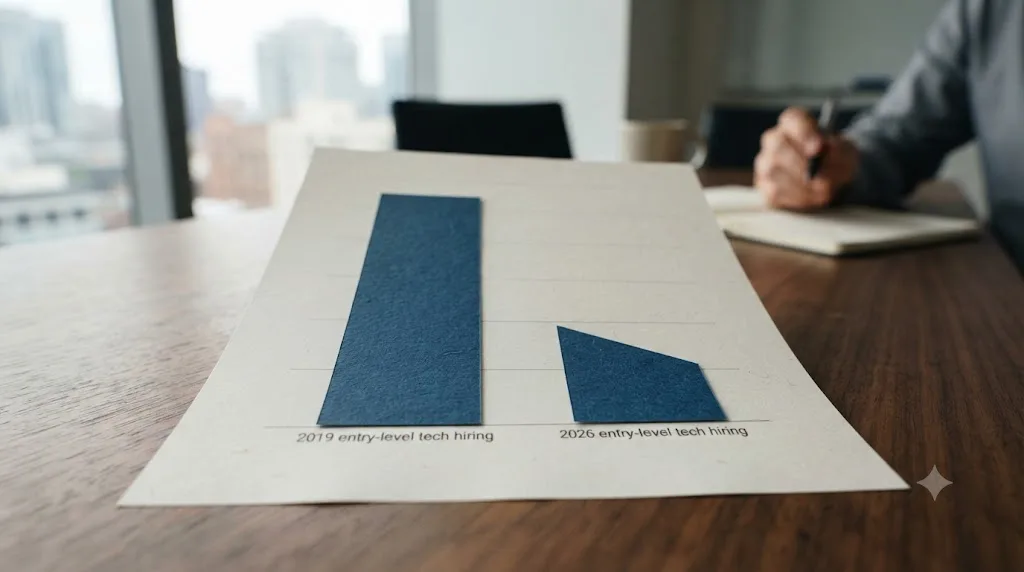
Is this really about AI, or just the same tech downturn that started in 2022?
Fair question, and worth taking seriously before assuming AI is the whole explanation. Tech had a real, AI-independent correction starting in 2022: interest rates rose, the pandemic hiring boom unwound, and companies that had overhired for 2020-2021 growth cut back. None of that had anything to do with large language models.
That's exactly why the Stanford methodology matters more than a single hiring headline. Brynjolfsson's team controlled for firm-level effects, meaning they didn't just measure "did hiring fall" (which the 2022 correction alone would explain), they measured whether young workers in AI-exposed roles fared worse than young workers in less AI-exposed roles at the same companies, and whether that gap held up even after excluding tech firms and remote-eligible jobs entirely. It did. Nela Richardson, ADP's chief economist and a co-author on the underlying data infrastructure, put the split plainly: "In the aggregate, AI's impact on jobs remains modest. But when AI's impact is measured by career stage, dramatic differences emerge."
That's the actual finding worth remembering. AI isn't shrinking employment across the board. It's specifically shrinking the entry-level rungs of the ladder, in occupations where AI substitutes for tasks rather than assisting with them, while leaving experienced workers in the same fields largely untouched. The 2022 downturn explains some of the overall softness. It doesn't explain why the pain is this concentrated on the youngest, least-experienced workers in exactly the roles AI is best at.
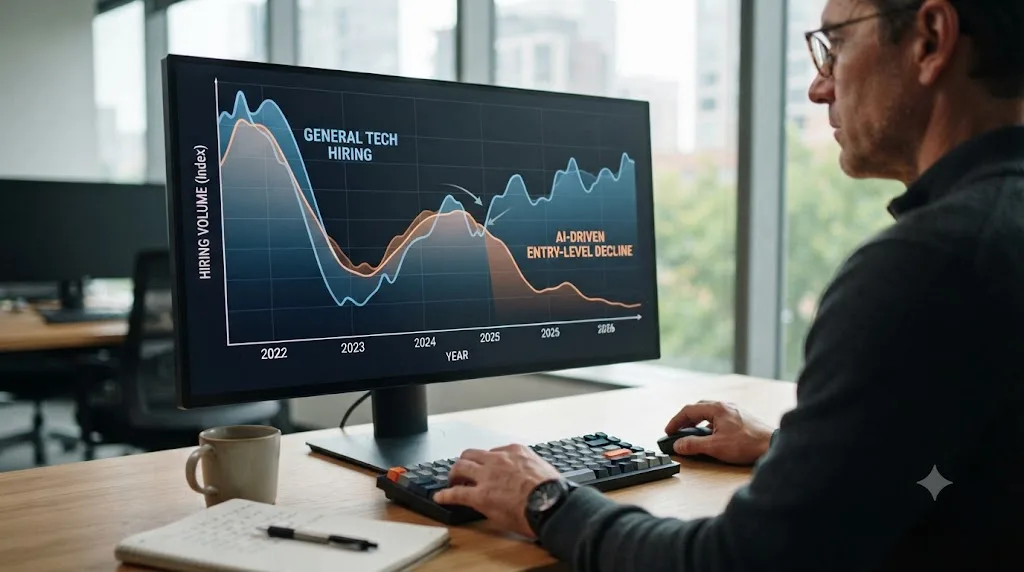
What exactly did Dario Amodei predict, and how much of it has actually happened?
Anthropic's CEO is the name attached to the loudest version of this warning, so it's worth quoting him precisely instead of the flattened "AI CEO says jobs doomed" version that circulated. In a May 2025 interview with Axios, Amodei said AI could eliminate half of all entry-level white-collar jobs within one to five years, and that the shift could push US unemployment to between 10 and 20 percent. He framed the warning as an obligation, not a marketing line: "We, as the producers of this technology, have a duty and obligation to be honest about what is coming."
He also said most people aren't ready to hear it: "Most of them are unaware that this is about to happen. It sounds crazy, and people just don't believe it." And on what he thinks the response should look like, he was specific that stopping the technology isn't realistic: "You can't just step in front of the train and stop it. The only move that's going to work is steering the train, steer it 10 degrees in a different direction."
Amodei repeated the 50 percent claim in a 20,000-word essay published in early 2026, so this isn't a one-off soundbite he's walked back. What has shifted, according to Forbes' coverage of his more recent comments, is his framing: he's talking more about jobs transforming and new categories of work emerging, less about pure disappearance, even while his underlying numeric claim hasn't changed. That's worth holding onto both halves of. The 50 percent figure is a prediction from someone with an obvious financial and reputational stake in AI's capabilities being taken seriously, not an independently measured outcome. The Stanford data, by contrast, is a measured outcome, and it's smaller in magnitude (16 percent, not 50) but it's real, not speculative, and it points the same direction Amodei is pointing.
Two other data points make the broader white-collar version of Amodei's claim harder to dismiss as pure hype. An MIT study, cited in Forbes' coverage, found AI could already technically replace 11.7 percent of the US labor market, roughly $1.2 trillion in wages concentrated in finance, healthcare, and professional services. And Wall Street banks including Goldman Sachs, JPMorgan, and Morgan Stanley are reportedly planning to cut around 200,000 roles over the next three to five years, with the cuts concentrated in entry-level analyst programs, the exact tier of job that used to be a first-year banker's on-ramp, the same way a CRUD ticket used to be a junior developer's on-ramp.

Which junior developer tasks has AI already taken over?
This is the part the hiring statistics can't show you on their own: which specific tasks moved from "why we hired a junior" to "why we don't need to anymore." Rachit Gupta, head of AI at Tredence, told CIO the honest version: "In the near term, it's true that many of the tasks junior developers used to do like fixing bugs, writing test scripts, and cranking out boilerplate code, are now the kinds of things AI tools handle well."
That list matters because it's precise. It's not "junior developers are obsolete." It's a specific set of tasks: boilerplate scaffolding, routine bug fixes, unit test generation, basic refactors, first-draft documentation. Those tasks share a trait that made them perfect junior-developer work in the first place, and also made them perfect for AI to absorb: they're well-specified, low-risk if wrong, and easy to verify against a spec. That's exactly the profile of task a language model is good at, and exactly the profile of task companies used to hand a new hire while they learned the codebase.
Zeel Jadia, CEO and CTO at ReachifyAI, framed the business logic behind the shift to CIO in blunter economic terms: "Business priorities shift with economic conditions, and right now the baseline team is smaller, powered by AI-assisted developers." And a senior software engineer quoted in the same piece put the calculation in the terms a finance team actually runs: why hire a junior developer at a competitive salary when a coding assistant subscription costs a fraction of that and covers the same routine work.
None of this means the judgment layer of junior developer work has been automated. It means the on-ramp tasks, the ones a company used to be willing to pay a new hire to learn on, have been. That's the actual mechanism behind the hiring numbers in the section above: it's not that AI writes better code than a human senior engineer. It's that AI writes acceptable code for the exact category of task a junior used to be hired to do while they were still learning everything else.
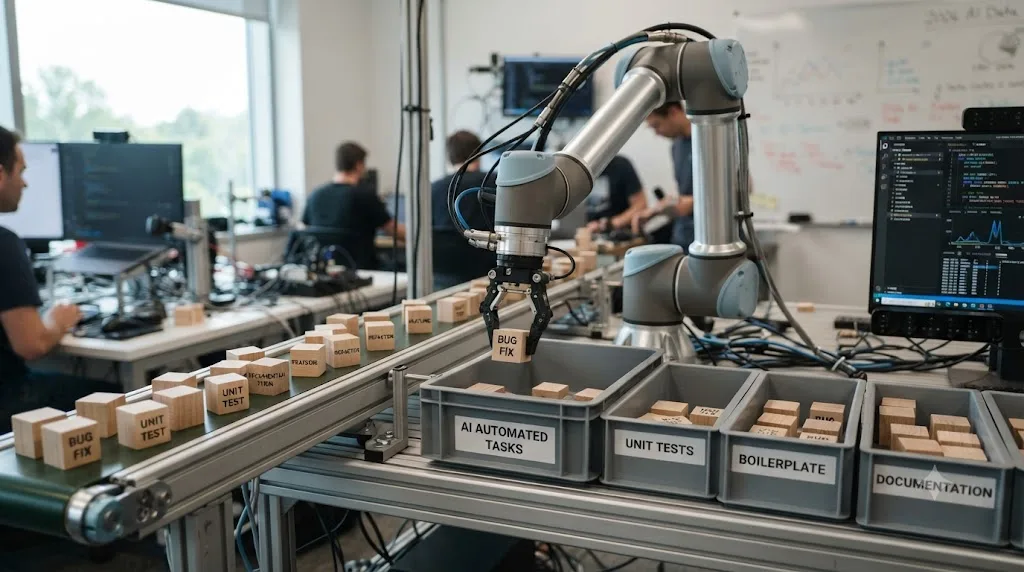
Why hasn't AI replaced junior developers completely, even where it clearly could?
Because writing code and being responsible for code are different jobs, and AI still only reliably does the first one. Stack Overflow's 2025 Developer Survey is the clearest evidence of that gap, and it comes from developers themselves, not from a vendor with something to sell. AI tool usage climbed past 84 percent of respondents using or planning to use AI tools. Trust in the accuracy of that output fell to 29 percent, down from 40 percent the year before. More developers actively distrust AI-generated output (46 percent) than trust it (33 percent), and the single biggest frustration, cited by 45 percent of respondents, is dealing with AI answers that are "almost right, but not quite," which often makes debugging take longer than writing the code from scratch would have.
Developer trust in AI-generated code dropped to 29 percent in 2025, even as AI tool usage among developers climbed past 84 percent. That gap between usage and trust is the whole reason junior developers still get hired at all. Someone has to read the AI's output, catch the subtle bug it introduced, and be accountable when it's wrong in production. Right now, that someone is still a person, and a huge share of that verification work is exactly the kind of close-reading, catch-the-mistake task a junior developer, working under a senior's review, is well suited to do.
There's a second reason, less about capability and more about structure: the codebase judgment problem. Reading a fifty-thousand-line legacy system, understanding why a change three services away might break something unrelated, knowing which shortcuts are safe and which ones will page someone at 2am, none of that lives in a spec an AI tool can read. It lives in institutional context a person accumulates by working in the system over time. AI can write a function. It can't (yet, reliably) tell you whether that function is the right one to write given everything else true about your specific system.
| Task category | Who does it now | Why |
|---|---|---|
| Boilerplate, CRUD endpoints, scaffolding | AI, mostly unsupervised | Well-specified, low-risk, easy to verify |
| Routine bug fixes with a clear repro case | AI drafts, human reviews | Specified problem, but wrong fixes can hide new bugs |
| Unit test generation | AI drafts, human checks coverage | Fast to generate, easy to miss edge cases silently |
| Judgment calls on architecture or tradeoffs | Human, AI assists | Requires context AI doesn't have access to |
| Reviewing AI-generated code for correctness | Human, increasingly the core junior task | This is where the accountability actually sits |
| Cross-team coordination, on-call ownership | Human | Not a coding task at all |
Notice the shift in that table. The junior developer job hasn't disappeared. It's moved down a row, from writing the first draft to reviewing and correcting one. That's a real change in what the job feels like day to day, and it's arguably a harder skill to build, not an easier one, because catching a subtly wrong answer requires more judgment than writing a correct one from scratch.

Does the size of the company change how safe your job is?
Yes, significantly, and this is where averaging across "the tech industry" hides more than it reveals. SignalFire's data breaks the entry-level collapse down by company size, and the pattern isn't uniform.
| Company type | What's happening to junior hiring | Why |
|---|---|---|
| Big Tech (Magnificent Seven and similar) | Down roughly 65% vs. 2019 | Mature codebases, heavy AI tooling investment, leaner teams by design |
| Early-stage startups | Down roughly 76% vs. 2019, the steepest decline of any category | Smallest budgets, most direct incentive to substitute AI for a first hire |
| Mid-size, growth-stage companies | Softer decline, more variable | Still building teams, sometimes need juniors to scale fast even with AI tools in place |
| Traditional enterprise (non-tech industries hiring developers) | Slower to cut, slower to adopt AI tooling at scale | Legacy processes and compliance overhead slow both AI adoption and headcount cuts |
The intuitive assumption, that big, AI-forward tech companies would be the safest place to start a career, actually inverts here. The companies most aggressively investing in AI coding tools are also the ones cutting entry-level hiring the hardest, because they're the ones best positioned to feel the substitution effect first. SignalFire's report also found that 37 percent of managers said they'd rather use AI than hire a Gen Z employee, a striking number precisely because it's a stated preference, not just a budget constraint being described after the fact.
Traditional enterprise employers outside pure tech, banks running internal engineering teams, retailers, healthcare systems, adopt both AI tooling and headcount cuts more slowly, partly out of caution and partly out of bureaucratic inertia. That's not a permanent safe harbor, but it is, right now, a place where the entry-level door is closing more slowly than it is at a Series A startup or a Big Tech company optimizing headcount against AI-assisted output per engineer.

Is this happening to other entry-level white-collar jobs too, or just software?
Just software gets the headlines because coding assistants were the most visible, most widely adopted category of workplace AI first. But the underlying mechanism, AI absorbing the well-specified, easily-verified tasks that used to be an entry point into a profession, isn't unique to engineering.
Wall Street is the clearest parallel. Goldman Sachs, JPMorgan, and Morgan Stanley have all publicly invested in AI for the kind of work first-year analysts used to be hired to do: building models, drafting memos, running comparables. Reported plans put roughly 200,000 roles at risk across those firms over the next three to five years, concentrated in exactly the entry-level analyst tier. That's not a coding story at all, and it maps onto the same pattern the Stanford study found in software: young workers doing well-specified, easily-automated tasks are the first ones affected, while experienced staff making judgment calls stay largely insulated.
The MIT figure cited earlier, 11.7 percent of the US labor market technically replaceable by AI right now, representing roughly $1.2 trillion in wages, spans finance, healthcare, and professional services broadly, not just software. So if you're a junior developer wondering whether to pivot into a different white-collar field to dodge this trend, the honest answer is that most adjacent fields are facing some version of the same pressure, just on a slightly different timeline depending on how well-specified and easily-verified their entry-level tasks happen to be.

What should you actually do to get hired as a junior developer in 2026?
Everything above is diagnosis. Here's what actually moves the needle, based on what every source in this piece agrees is still scarce even as AI absorbs the routine tasks.
Ship real, finished projects instead of tutorial clones. A portfolio full of "todo app" and "clone of X" projects, finished by following someone else's steps, signals recognition, not capability, to anyone reviewing it. The distinction matters more now than it used to, because AI can generate a plausible-looking tutorial clone for you in minutes, which means a recruiter has learned to discount them almost entirely. A messy, real, self-directed project, something you had to make actual decisions about, with no tutorial to copy, is what still signals you can operate without someone else's steps in front of you. Our breakdown of why watching tutorials doesn't build skill covers the underlying mechanism: watching trains recognition, and recognition is exactly the layer AI has automated. Building your own project, badly, from a half-formed idea, trains the recall and judgment layer AI hasn't.
Learn to review AI output, not just generate it. Given the Stack Overflow trust numbers above, the single most valuable junior-level skill in 2026 might be catching an AI's subtly wrong answer before a senior engineer has to. That's a distinct, trainable skill: reading generated code slowly, asking what edge case it missed, checking it against the actual requirement instead of trusting that it compiles. Practice this deliberately, on your own projects, before you're asked to do it under pressure on someone else's codebase.
Contribute to something real and public. Open source contributions, even small ones, are verifiable, timestamped evidence of you working inside an unfamiliar codebase and getting a change merged by people who didn't have to say yes. That's a harder signal to fake than a resume bullet, and it directly demonstrates the codebase-judgment skill from the earlier table, the one AI still can't reliably do on its own.
Be able to explain a tradeoff, not just produce an output. In an interview, the question that separates an AI-native candidate from an AI-dependent one isn't "can you write this function." It's "why did you write it this way instead of the other way," and whether you can answer that from your own understanding instead of repeating what a chatbot told you. Practice narrating your own decisions, out loud, before you're asked to defend them live.
Target company size deliberately, not by prestige. Given the SignalFire breakdown above, a traditional enterprise team or a growth-stage company actively scaling might currently offer a more realistic entry point than a Big Tech company that's optimizing headcount against AI-assisted output per engineer. Don't assume the most famous logo is the safest bet. Right now, it's often the opposite.
If you already have a junior role, how do you keep it?
The same underlying skill that gets you hired is the one that keeps you employed once you're in: being the person who catches what AI gets wrong before it ships, not the person who forwards AI's output unread. A few concrete habits follow from that.
Ask for code review responsibility earlier than feels comfortable. Reviewing a senior's pull request, even badly at first, builds the exact pattern-matching skill that separates a developer who can be trusted with AI-assisted output from one who can't. Volunteer for the on-call rotation once you're ready, because incident response, tracing a production bug back to its actual cause under time pressure, is squarely in the "judgment AI doesn't have" column from the task table above, and being good at it is hard to automate around.
Push to own something end to end, even something small, rather than only picking up well-specified tickets. A feature you designed, shipped, and are accountable for when it breaks builds a different kind of resume line than "closed forty tickets," and it's the kind of evidence a manager making layoff decisions actually weighs, because it shows judgment under ambiguity, not just execution against a spec.
There's a longer-term risk worth naming honestly, one that ThinkPol and others in the reporting above have flagged: if companies stop hiring and training juniors at scale now, the senior engineer pipeline five to ten years out gets thinner across the entire industry, not just for you individually. That's a real structural problem this piece can't solve for you. What it does mean, practically, is that the juniors who do get hired and do get real mentorship right now are getting an unusually fast-tracked path toward becoming the scarce senior talent of the early 2030s, precisely because so few companies are investing in that pipeline today.
Is it still worth becoming a software engineer at all?
Yes, with a caveat worth stating plainly: the entry point is harder than it was in 2019, and it's fair to expect that to continue for a few more years before it eases. But "harder to get in" and "the field is dying" are different claims, and the long-run data supports the first one, not the second.
The US Bureau of Labor Statistics still projects 15 percent employment growth for software developers, quality assurance analysts, and testers between 2024 and 2034, about five times the average projected growth across all occupations, with roughly 129,200 openings projected annually over the decade. That projection accounts for AI's expected impact; it isn't a pre-AI number that's about to be revised into irrelevance. It's also worth being honest about a limitation in the other direction: the New York Fed's recent-graduate unemployment figures, the 6.1 percent for computer science and 7.5 percent for computer engineering cited earlier, come from 2023 American Community Survey data, filtered for 22-to-27-year-olds with a degree. That's real data, but it's not live 2026 data, so treat it as a snapshot of a trend that was already underway, not this week's number.
Put the two data points together and the honest picture looks like this: the profession isn't shrinking in the long run, but the junior rung of the ladder has gotten narrower and more competitive, probably for the next several years, before the senior pipeline shortage the previous section mentioned starts pulling demand back the other way. If you're choosing a career, that's a real cost, worth weighing against your specific circumstances, not a reason to assume the field has no future.
So what's the actual bottom line?
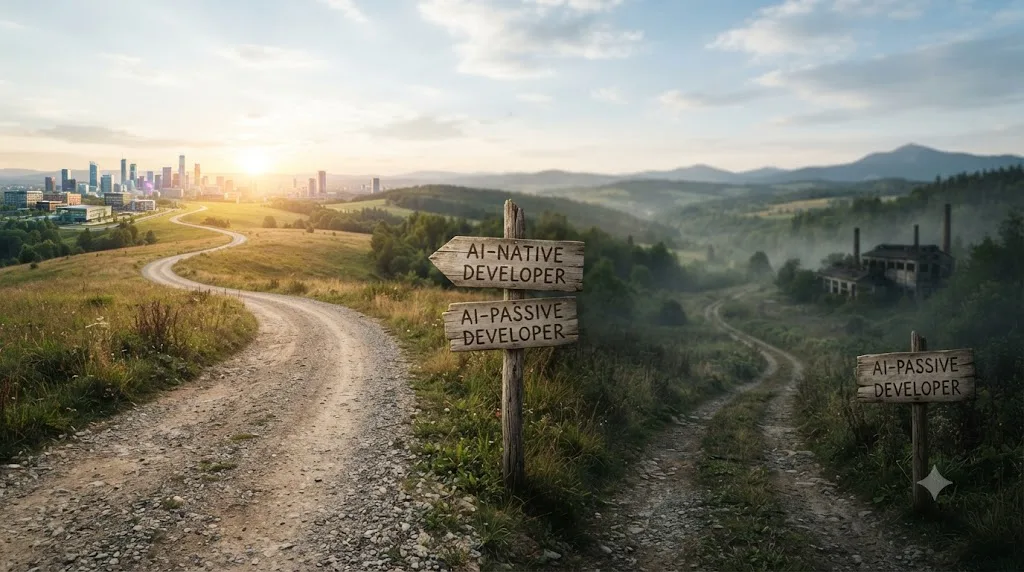
AI hasn't eliminated junior developers as a job title. It has eliminated the specific, low-judgment tasks companies used to justify hiring one for in the first place. That's why the hiring numbers are down sharply while the field's long-term growth projection hasn't collapsed. Both things are true at once, and pretending only one of them is the whole story gets you either false panic or false comfort, neither of which helps you actually get hired.
The pattern running through every source in this piece, Stanford's economists, SignalFire's recruiters, Stack Overflow's own developers, is the same one underneath the sibling piece on this site about why passively watching a tutorial doesn't build skill: the value AI can't replace is judgment built through doing the work yourself, not recognizing it done by someone, or something, else. That's the same idea behind tools built to help you build real skill rather than skip past it, including the kind of hands-on, in-the-work AI assistance TryUncle is built around for a completely different craft, DaVinci Resolve editing: augmenting the person doing the work, not replacing the judgment that only forms by doing it.
If you're trying to break in right now, don't wait for the entry-level market to loosen up before you start building the thing that actually gets you hired in it. Ship something real this week, badly if you have to, and make sure you can explain every decision in it without a chatbot's help.
Frequently asked questions
- Will AI replace junior developers in 2026?
- Not as a job category, but it's already replacing the specific tasks companies used to hire juniors for, like boilerplate code, simple bug fixes, and test scripts. Stanford's payroll-data study found a 16% relative decline in employment for AI-exposed workers aged 22 to 25, and SignalFire found new-grad hiring at the largest tech companies down more than 50% since 2019. Companies are hiring fewer juniors, not replacing the ones they keep with software.
- What percentage of entry-level tech jobs has AI eliminated?
- There's no single clean percentage, because the studies measure different things. Stanford found a 16% relative employment decline for AI-exposed 22-to-25-year-olds compared to older workers in the same occupations. SignalFire found entry-level hiring down roughly 65% at major tech companies and 76% at early-stage startups versus 2019. Neither number means AI directly caused every lost job; both point the same direction.
- What did Dario Amodei actually say about AI and entry-level jobs?
- Anthropic's CEO told Axios in May 2025 that AI could eliminate half of all entry-level white-collar jobs within one to five years and push unemployment to between 10% and 20%. He repeated the claim in a 20,000-word essay in early 2026, though he's since shifted more of his public framing toward jobs transforming rather than simply vanishing.
- What junior developer tasks can AI already do well?
- Boilerplate code, simple bug fixes, unit test scaffolding, basic refactoring, and documentation, according to Rachit Gupta, head of AI at Tredence, speaking to CIO. These are exactly the tasks that used to be a junior developer's on-ramp: low-risk, well-specified work a new hire could do while learning the codebase.
- Is it still worth becoming a software engineer in 2026?
- The US Bureau of Labor Statistics still projects 15% job growth for software developers from 2024 to 2034, about five times the average for all occupations. The near-term entry point is harder and the bar for a first job is higher, but the long-run demand projection hasn't collapsed. The honest read is a rough five years to get in, not a dying field.
- How can a junior developer stand out when companies are cutting entry-level hiring?
- Ship real, finished projects instead of tutorial clones, learn to review and correct AI-generated code instead of just accepting it, and be able to explain the tradeoffs behind a decision, not just produce working output. Every source in this piece agrees on the same underlying skill: judgment about whether AI's answer is actually right, which is exactly what AI itself can't verify for you.
- Are senior developers safe from AI-driven job cuts?
- Safer, but not immune. Indeed Hiring Lab found that 71% of the 2025-2026 rebound in software development job postings came from senior roles, and Stanford's study found employment for experienced workers in AI-exposed occupations stayed stable or grew while early-career employment fell. The risk is concentrated at the entry level, not evenly spread across the profession.
- Is the junior developer job market recovering in 2026?
- Partially, and unevenly. Indeed found software development postings up almost 15% since February 2025, but the total remains about 27.5% below pre-pandemic levels, and most of the recovery is senior hiring. Read a single 'tech hiring is back' headline skeptically until you check whether the roles it's counting are actually entry-level.
Sources
- Canaries in the Coal Mine? Six Facts about the Recent Employment Effects of Artificial Intelligence (Brynjolfsson, Chandar, Chen — Stanford Digital Economy Lab)
- 'It's not going away': The Stanford economist who called the AI entry-level jobs crisis early has the receipts (Fortune)
- Behind the Curtain: Top AI CEO foresees white-collar bloodbath (Axios)
- AI could make half of all entry-level white-collar jobs vanish, Anthropic CEO warns (Fortune)
- Dario Amodei Doubled Down On His AI Jobs Warning. Here's What's Different Now (Forbes)
- The SignalFire State of Tech Talent Report - 2025
- Sorry, grads: Entry-level tech jobs are getting wiped out (The San Francisco Standard)
- Demand for junior developers softens as AI takes over (CIO)
- AI and Job Postings: From Destruction to Creation? (Indeed Hiring Lab)
- AI vs Gen Z: How AI has changed the career pathway for junior developers (Stack Overflow)
- Developers remain willing but reluctant to use AI: The 2025 Developer Survey results are here (Stack Overflow)
- Software Developers, Quality Assurance Analysts, and Testers: Occupational Outlook Handbook (U.S. Bureau of Labor Statistics)
- The Labor Market for Recent College Graduates (Federal Reserve Bank of New York)
Learn by doing, not watching
Stop translating tutorials to your timeline.
TryUncle stays beside Resolve on Mac and Windows. When you ask, Uncle sees your screen and points at the exact control you need. No hunting through tabs, timestamps, or mismatched tutorials.
Meet TryUncleKeep reading
 GuidesJul 8, 202629 min read
Why Watching Tutorials Doesn't Work (And What Actually Builds Skill)
Why watching tutorials doesn't work: it trains recognition, not recall. The research on active practice, retrieval, and how to actually break out of tutorial hell.
 ComparisonsJul 8, 202633 min read
12 Best Udemy Alternatives in 2026 (Free and Paid)
We compared 12 Udemy alternatives, free and paid, to help you pick the right one for what you're actually trying to learn.
 ComparisonsJul 11, 202626 min read
The Best AI Tools to Learn DaVinci Resolve in 2026
ChatGPT, Claude, Blackmagic's free training, Recut, and Resolve's Neural Engine compared for learning DaVinci Resolve, and the gap none of them close.